
New Alabama law aims to improve police interactions with people with disabilities
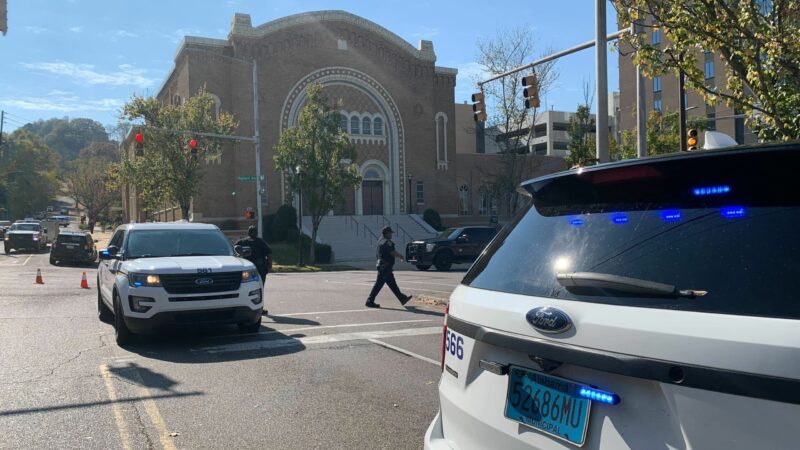
In this file photo, Birmingham police block roads around Temple Beth-El on Friday, November 4, 2022. A new mandate will require Alabama law enforcement officers to train on working with people with “invisible” disabilities and sensory needs.
A new Alabama mandate requires law enforcement officers to train in working with people with “invisible” disabilities and sensory needs, including people with autism, stroke survivors, post-traumatic stress disorder and other conditions.
Known as the Cade Noah Act, the Alabama law went into effect on Jan. 1. It says the state’s certified officers must complete an hour-long training every other year on working with people who have invisible disabilities. The law is named for its sponsor’s son, who has autism, reports said.
Advocates said such trainings have generated interest in the Gulf South, as autism incidence rates increase and encounters where officers hurt or killed someone with autism have made grim headlines. Salt Lake City, the Twin Cities’ suburbs and Los Angeles all have seen such cases recently.
“You can Google situations and it’ll come up all around the country, different stories of how it’s gone horribly wrong. And I watch these and most of it, it’s just because they haven’t been trained,” said Bill Cannata, Autism and Law Enforcement Education Coalition program coordinator for Massachusetts-based Lifeworks.
Cannata says the program he shepherds has worked with groups and partnerships to help train first responders in Louisiana, Mississippi and Alabama, as well as many other states. It saw its largest-ever audience, of more than 300 first responders, in Baton Rouge at a training about six years ago.
The Birmingham-area nonprofit KultureCity will administer the new training at no cost to law enforcement agencies in Alabama. Co-founder Julian Maha said the group first developed the training at the request of Salt Lake City officials, brought it back to Alabama and now has broadened its reach with the new requirement.
As in Alabama, lawmakers in the region’s other two legislatures have lately tried to integrate such trainings into statutes related to law-enforcement infrastructure, with varied results.
Act 137 of 2020 required Louisiana’s Department of Public Safety and Corrections to establish a law-enforcement training course for working with people with autism, “to ensure equitable treatment” and improve communication.
Bills aiming to require Mississippi’s public safety department to develop a new autism training have died in committee at least twice, according to legislative records. State Rep. Christopher Bell has introduced a similar bill in the Mississippi legislative session that began this month.
Dustin Chandler, a former police officer who works with self-advocates to give first-responder autism and disability training courses in Alabama and Louisiana, says police chiefs would tell him they didn’t have any people with autism in their district when he started doing the work in 2015. Now, things have changed quite a bit since then.
“Our training is really safety training. … It’s to make sure that one you as a first responder are safe, but also equally and making sure everybody on the scene is safe,” said Chandler, who is president and co-founder of the Alabama-based Interaction Advisory Group.
Alabama parents respond
Two parents in Opp, Alabama said the new law seems like a starting point for officers dealing with people with invisible disabilities, which they note spans a wide gamut of conditions.
Wesley and Kristy Thompson, whose son has autism, run a Facebook group for autism-related support. The Thompsons’ 14-year-old is a musical child — he loves playing a glockenspiel they got him — but he is nonverbal.
They have worried about what would happen if he interacted with a police officer in an unfamiliar setting.
“If somebody come[s] running at him, he’s going to run away because he thinks, oh, we’re playing chase,” said Wesley Thompson. “That could turn out to be a very bad situation.”
“Lights flashing, sirens going, even [for] a passenger who has autism … it can get scary,” Kristy Thompson agreed.
Wesley Thompson’s brother is a retired police officer, so both Thompsons are sympathetic to the pressures officers face making split-second calls. Wesley Thompson even tried to set up training with his local police department on working with people with autism, but the scheduling never worked out.
He called the new law an improvement to be proud of, but urged first responders to view what’s required as the “bare minimum.”
“These law enforcement agencies and other first responders obviously [can] take it upon themselves to expand on that hour,” he said.
‘I really didn’t know’
The specific course material of the newly required Alabama training can’t be shared, said Maha. But advocates who have been working in the space described several approaches they touch on with this type of training.
Cannata, who also is a retired firefighter and parent to an adult son with autism, says sensory input can be painful or trigger a “fight or flight” response in some people with autism. For that reason, if it’s safe for officers to turn off lights and sirens, sometimes that can be helpful.
Chandler said police might misinterpret a lack of eye contact or repetitive movements — common in some people with autism or other disabilities — as suspicious. It helps a lot when officers can more easily identify someone’s conditions, like with a license plate or driver’s license sticker.
Physical contact to defuse a situation might not work as well, he explained. He notes that some people with autism have differences in the way they experience pain and may be more affected by being touched.
For officers, working with people with disabilities is a question of learning to communicate, thinking about their options in the moment and making adjustments, he said.
“Back when I was on patrol, if I had somebody with a mental health condition, I really didn’t know what to do,” said Chandler.
This story was produced by the Gulf States Newsroom, a collaboration between Mississippi Public Broadcasting, WBHM in Alabama, WWNO and WRKF in Louisiana and NPR.
This historian dug up the hidden history of ‘amateur’ blackface in America
In her new book, Darkology, historian Rhae Lynn Barnes writes about how blackface and minstrel shows became one of the most popular forms of entertainment in 19th- and 20th-century America.
Attempted attack with explosives in New York City investigated as “ISIS-inspired terrorism”
New York City NYPD Commissioner: "Explosive devices that could have caused serious injury or death."

Trump is using immigration policy to suppress speech, lawsuit claims
A new lawsuit accuses the administration of violating the First Amendment by threatening the visas of researchers for work on disinformation and content moderation of social media.

Why young girls are disguised as boys in Afghanistan
The Taliban has released a video of an interrogation of a girl who passed as a boy. It's an age-old practice in this patriarchal society but now appears to be happening with some frequency.

Live Nation and Justice Department reach settlement in antitrust case
The trial, which began a week ago in a New York City courtroom, aimed to break up Live Nation and its subsidiary, Ticketmaster.

Microshelters for Birmingham’s unhoused set to open soon
The pilot program called Home For All involves building 14 small pallet homes to house those who would otherwise be living on the streets.
