
This swampy paradise is Alabama’s winter haven for sandhill cranes
This story is part of a monthly series called Outdoor Connections, which features stories that explore the biodiversity of Alabama and how we depend on it.
Walking along the gravel paths of Wheeler National Wildlife Refuge, park ranger David Young looks to the sky as a flock of sandhill cranes soars overhead, emitting a loud chorus of sounds.
“I just love that call. It’s very dinosaur-like,” Young said.
With a wingspan that measures up to five feet, sandhill cranes typically have gray feathers, with a bright red patch on their foreheads.
As the birds fly in unison, they stretch out their long thin necks and point their skinny legs behind them, enjoying a chilly day on the swampy refuge in Decatur.
“We have three things that they really like,” Young said. “We have water. We have open fields that are relatively undisturbed. And we have the groceries. We have the food.”
With 35,000 acres nestled near the Tennessee River, Wheeler staff work with cooperative farmers to grow crops like corn, leaving behind a portion for the cranes to forage.
The refuge is home to hundreds of diverse species of birds, fish, reptiles, mussels and more. But the cranes bring the crowds.
As many as 25,000 sandhills migrate to Wheeler every winter, along with a handful of highly endangered whooping cranes.
Nature enthusiasts can visit the refuge throughout the season to catch a glimpse of the tall waterfowl. But the annual Crane Festival, hosted with assistance from the Wheeler Wildlife Refuge Association, is set aside every January to observe and celebrate the birds.
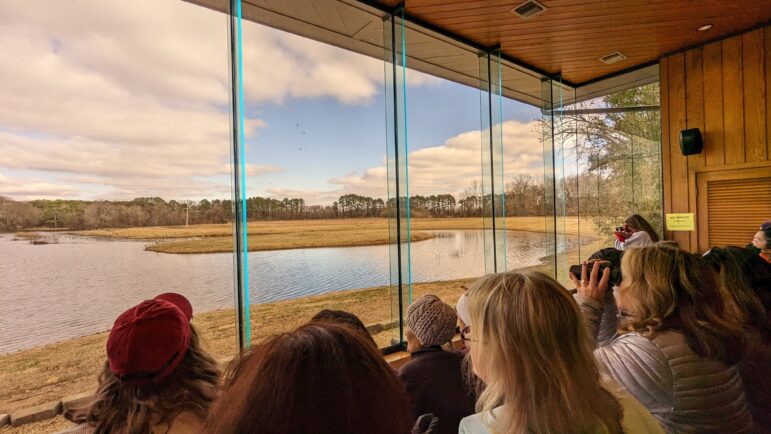
“It’s been great,” said nine-year-old Lara Badri of Nashville, who attended the festival with her family. “I saw a lot of sandhills. But I’ve been trying to see whooping cranes.”
Compared to the sandhills, whooping cranes are about a foot taller, with bright white feathers. And they’re much less common.
Highly endangered, there are approximately 836 whooping cranes in the world, according to the International Crane Foundation (ICF), a non-profit that works to protect and reintroduce the species worldwide. Current numbers, while low, reflect decades of conservation efforts, rebounding from a population of fewer than 20 birds in 1941.
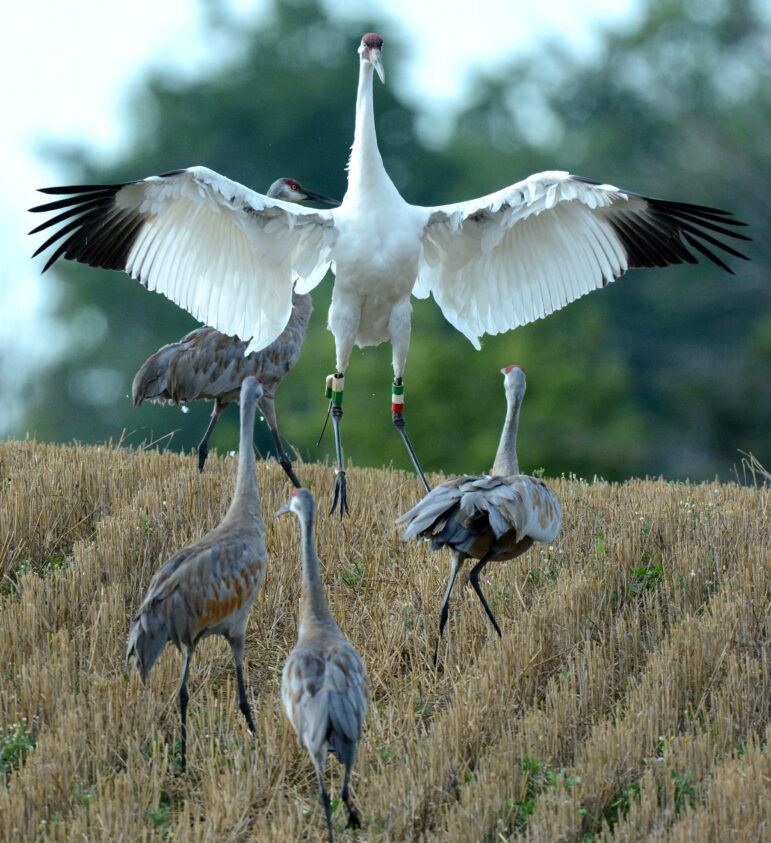
“Once I heard they actually got revived by scientists, I’ve always wanted to see one,” Badri said.
This year, 13 of the rare birds have been spotted on the refuge, a few less than past seasons.
Legina Jenkins, a volunteer with ICF, spends the winter months driving across north Alabama looking for the whooping cranes. She knows each bird’s quirks.
“There’s four of them that stay together. I refer to them as the fab four,” Jenkins said. “Then there’s one that stays at the visitors center all by herself with the sandhills. And then there’s another pair that stays in a real secluded area. They don’t like company. They stay real isolated.”
Jenkins said one of the female cranes returned this year without her mate, who appears to have gone missing during migration.
“We’re really afraid that something’s happened to him, but we don’t know for sure,” Jenkins said.
Both whooping cranes and sandhill cranes typically mate for life, and they both have a robust collection of dance moves they use to communicate.
The refuge is equipped with outdoor viewing platforms, boardwalks and an indoor observation deck for visitors to observe the birds in action.
While spotting a whooping crane is difficult, bird watchers are rewarded with hundreds, if not thousands, of sandhill cranes that gather together across miles of wetlands.
“There’s a lot of them,” said Danielle Ford of Harvest. “I was interested to see, when we were driving up, the big flock of them. I was like ‘wow.’ I hadn’t seen that many at one time.”
Sandhill cranes are numerous now, with more than 500,000 birds worldwide, but the species was also once near extinction, the result of habitat loss and overhunting about a century ago.
The species recovered thanks to conservation efforts, so much so that a few years ago, Alabama reinstated a sandhill hunting season, although no hunting is allowed on the refuge.
Both the sandhill and the whooping cranes are expected to stay at Wheeler for a few more weeks before heading back north.
Do you have an idea worth featuring as part of our Outdoor Connections series? Email [email protected].

Israeli soldiers fire on family car in occupied West Bank, killing 4
Israeli soldiers fired on a car carrying a family in the northern West Bank, killing four people including two children, the Palestinian Authority's Health Ministry said.

U.S. military names six killed in plane crash as Iran war enters third week
The conflict in the Middle East has entered a third week, with Israel announcing a barrage of new strikes on western Iran on Sunday, while the U.S. defense department released the names of six service members who died when their military refueling aircraft crashed.

Alabama poised to drastically overhaul utility regulation. Will it lower electric bills?
The Alabama Senate unanimously voted to expand the public service commission, and create a Secretary of Energy to address rising electricity prices. A bill in the House would go even further, requiring rate case hearings and limiting utility profits.

Acclaimed 20th century philosopher Jürgen Habermas dies at 96
Associated with the Frankfurt School, Habermas was a world-renowned thinker on modernity and democracy who helped shape German post-war and post-reunification political discourse.

Why the Chicago Bears could be moving to Indiana
While Illinois is trying to keep the team in Chicago's suburbs, Indiana lawmakers are offering a plan to finance a new stadium

Pentagon tightens controls over Stars and Stripes after calling it “woke”
The new rules for the independent military newspaper are the Defense Department's latest effort to put extraordinary restrictions on journalists covering the agency.
