
Judge weighs request to block Alabama transgender law
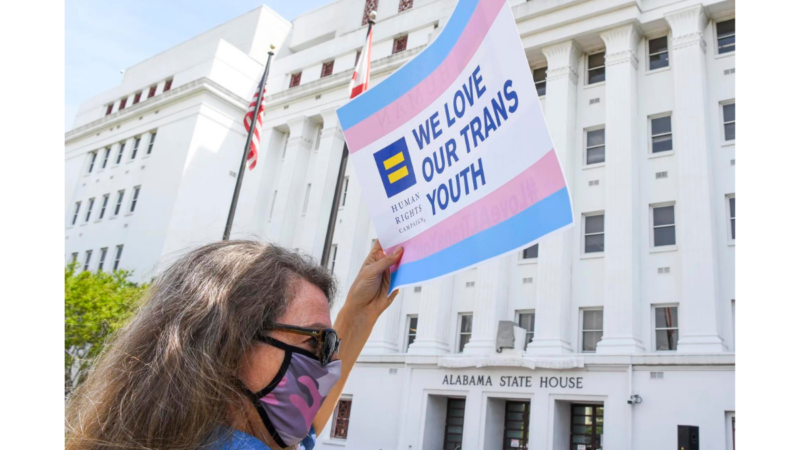
Jodi Womack holds a sign that reads "We Love Our Trans Youth" during a rally at the Alabama State House to draw attention to anti-transgender legislation introduced in Alabama on March 30, 2021 in Montgomery, Ala.
MONTGOMERY, Ala. (AP) — Alabama will ban the use of puberty blockers and hormones to treat transgender minors starting on Sunday, barring a ruling by a federal judge on a request to block the law from taking effect.
The U.S. Department of Justice and parents with transgender children have asked the judge to prevent the state from enforcing the statute while a lawsuit against it goes forward. U.S. District Judge Liles Burke, noting the lawsuit was filed in mid-April, said he and his staff will do “nothing else” but work on a decision though it might not come until after the law’s effective date.
“I can’t say if it’s going to be out tomorrow or the next day or the next day,” Burke said Friday. His comment came at the end of a two-day hearing on the injunction request.
The Vulnerable Child Compassion and Protection Act will make it a felony, punishable by up to 10 years in prison, for doctors and others to provide the medications to transgender people under age 19. The U.S. Department of Justice and four families with transgender children filed a lawsuit challenging the law as discriminatory, an unconstitutional violation of equal protection and free speech rights and an intrusion into family medical decisions.
Dr. Morrisa Ladinsky, a pediatrician who runs a gender clinic that treats children with gender dysphoria, said after the court hearing that it seems likely that the law will go into effect Sunday. But she still hoped that it would be for only a short amount of time.
“It would be only natural for any family with a transgender child to feel anxious, to feel scared and to feel in a place of limbo,” she said when asked how her patients were feeling. “So, we will hope that the wheels of justice act as they should, and we can allay those anxieties sooner rather than later.”
Jeff Doss, an attorney representing parents and others challenging the ban, said the law will harm the very children the state is claiming to protect by depriving them of the medical treatments that are backed by medical associations. Twenty-three medical and mental health organizations, including the American Academy of Pediatrics, have also urged the judge to enjoin the law.
“It supplants parental judgment and replaces it with the state’s … that no child should receive these medications,” Doss told Burke in closing arguments.
Attorneys for Alabama argued the ban should be allowed to go forward.
“The state has wide discretion to regulate areas of medical uncertainty,” Edmund LaCour, the solicitor general for Alabama, told the judge in closing arguments.” European countries, he argued, take a more reserved approach on the use of the medications with children.
During the hearing Burke put several questions to the attorneys, including asking who wrote the legislation and if parents could face prosecution for driving their children to another state to receive the medications. State attorneys said it was written by legislators, news outlets reported. LaCour replied that he did not think parents would trigger the statute by taking their children elsewhere.
A parent, testifying in a closed courtroom for privacy reasons, described the benefits her child has received, Doss said.
“She is seeing positive, transformative amazing benefits from these treatments the state has dubbed risky,” Doss said.
The state’s witnesses included a psychologist who testified that children may look to the label of transgender to explain feelings of being different or unhappiness, but those feelings often dissipate at puberty. Under cross-examination by Melody Eagan, James Cantor acknowledged he treats adults in his practice, not children.
Sydney Wright, 23, testified that she regrets lingering effects and possible infertility from getting testosterone prescribed at age 19 by a doctor in Georgia. Wright said at the time she desperately wanted the treatments to transition to being a man, but, “at the end of every single day I was a woman,” she said.
Lawyers noted on cross-examination that Wright, at age 19, would not have been affected by the law.
House Dem. Leader Jeffries responds to air strikes on Iran by U.S. and Israel
NPR's Emily Kwong speaks to House Minority Leader Hakeem Jeffries (D-NY), who is still calling for a vote on a war powers resolution following a wave of U.S.- and Israel-led airstrikes on Iran.
Iran’s Ayatollah Ali Khamenei is killed in Israeli strike, ending 36-year iron rule
Khamenei, the Islamic Republic's second supreme leader, has been killed. He had held power since 1989, guiding Iran through difficult times — and overseeing the violent suppression of dissent.

Found: The 19th century silent film that first captured a robot attack
A newly rediscovered 1897 short by famed French filmmaker Georges Méliès is being hailed as the first-ever depiction of a robot in cinema.
‘One year of failure.’ The Lancet slams RFK Jr.’s first year as health chief
In a scathing review, the top US medical journal's editorial board warned that the "destruction that Kennedy has wrought in 1 in office might take generations to repair."
Here’s how world leaders are reacting to the US-Israel strikes on Iran
Several leaders voiced support for the operation – but most, including those who stopped short of condemning it, called for restraint moving forward.

How could the U.S. strikes in Iran affect the world’s oil supply?
Despite sanctions, Iran is one of the world's major oil producers, with much of its crude exported to China.
