
Teaching Tough Topics: The South’s Real History
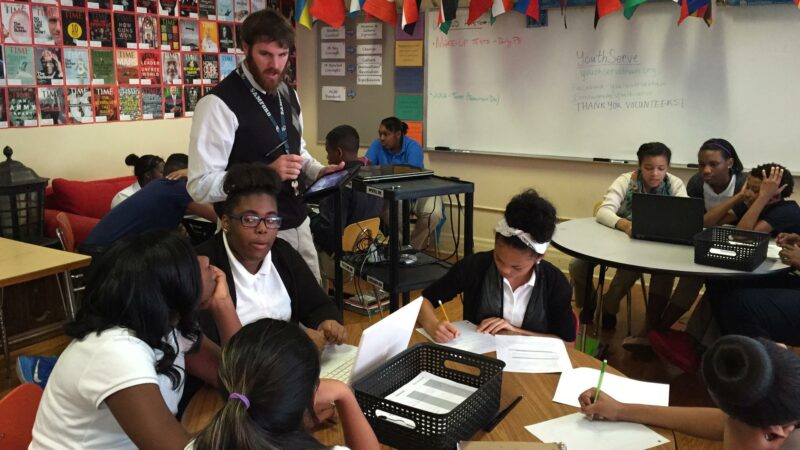
JohnMark Edwards steers his middle schoolers through a lesson at Birmingham's Phillips Academy.
Teaching subjects that trigger strong emotions and political divides is challenging. In the South, many of those fault-lines — racial, religious and otherwise — are intimately tied to its history. This week the Southern Education Desk is exploring how teachers tackle tough topics. WBHM’s Dan Carsen starts with an overview of some the major challenges, and some of the ways teachers can get around them. Listen above or read below. Please note this report contains language some might find offensive.
“It’s feeling and knowing that people have the convenience of ignoring the complexity of your identities. And oddly enough, the moment in which you don’t feel quite invisible is when the group of fraternity guys drives by in their truck on a Saturday night yelling ‘Roll Tide nigger!'”
That’s Elliot Spillers, president of the University of Alabama Student Government Association, speaking in a video he and other students produced in response to racial incidents there and around the country. In the same video, senior Amanda Bennett says she’s spent college in a pro-Confederacy environment and adds, “I go to class in buildings that are named for white supremacists, eugenicists, and slave owners.”
Now let’s be honest: hearing that puts some people on the defensive, and many others are at least surprised. But why? How did we get here?
I ask historian, educator, and author Robert Corley if the relevant history is being taught well. He answers in one word: “No.”
On the same question, award-winning Birmingham eighth-grade social studies teacher JohnMark Edwards elaborates, “There’s a lot that’s not talked about, not discussed. Sometimes administrators are interested more in the status quo, or in ‘easy’ … In my opinion, there’s a push in our culture to be politically correct at the expense of talking through really tough issues.”
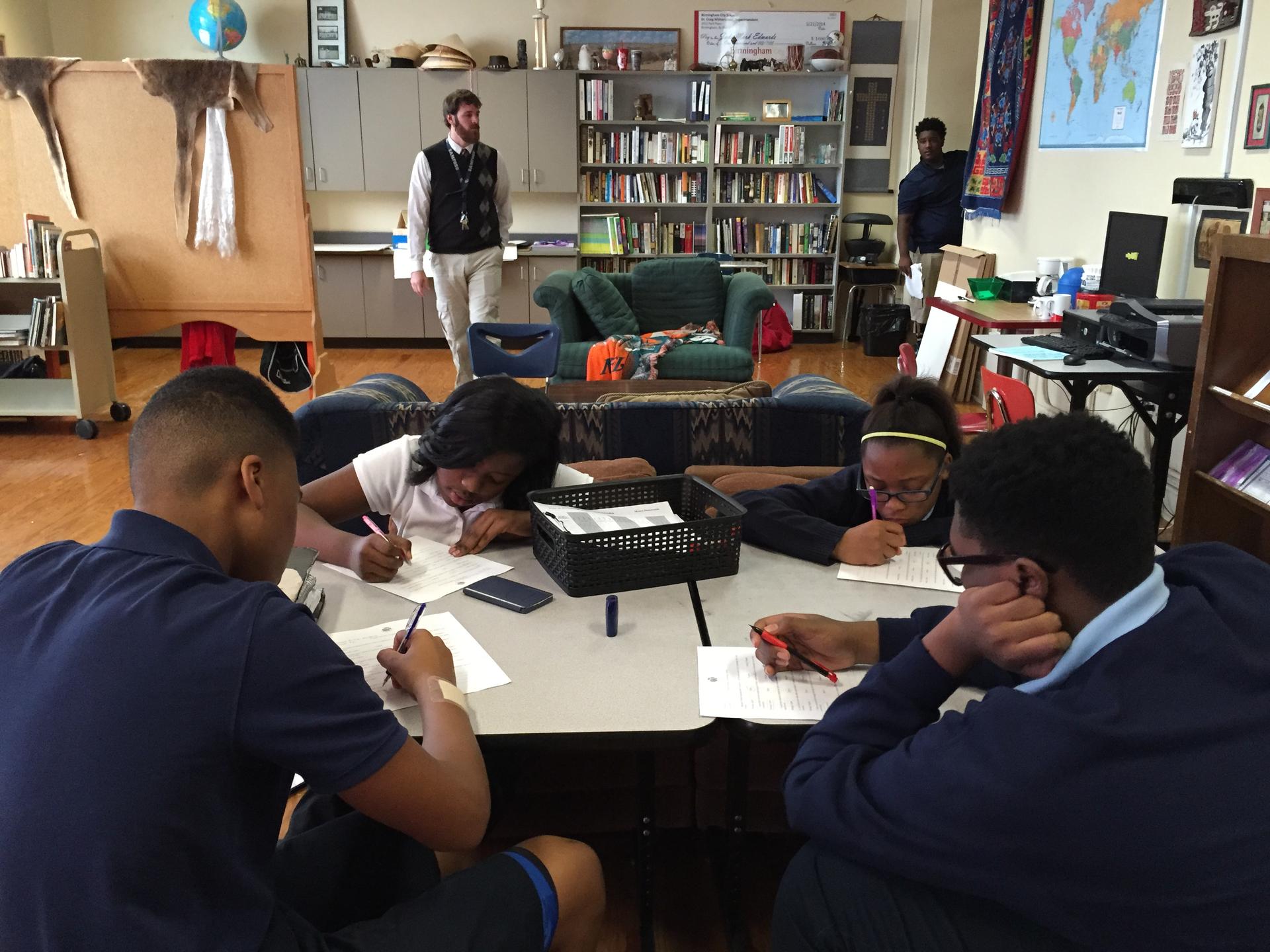
Dan Carsen, WBHM/SED
Edwards says when it comes to touchy history topics especially, he prefers to be more of a “facilitator,” setting things up so students can explore and discuss the issues themselves.
Edwards studied resistance to Birmingham school integration for his masters degree. That there was such a long and intense struggle here and elsewhere hints at another hurdle to understanding history, one both he and Corley mentioned: the dominant group’s view has been around for a very long time, but other sides of the story have only recently been expressed, let alone studied comprehensively.
On top of all that, says Corley, “Public education, the way it was structured in this country, was designed in part to not only educate students about skills that they needed, but also to indoctrinate citizens.” He points out that history textbooks mainly include virtuous white men doing things on certain key dates, and that the material is often taught not by trained historians but by educators who themselves learned “history” that way. Combine all of this with teachers running out of school year before getting to key units — think Civil Rights Movement — and you get post-secondary history-slaps:
“If you do go to college,” says Corley, “then you begin to get a little bit richer and more complicated view of the past, and it’s oftentimes shocking to people. You’re going to hear about topics like slavery, segregation, Jim Crow, the removal of Indian tribes … an enormous amount of violence in the American past.”
And since not everyone goes to college, teachers like Edwards are even more important. Besides being well-versed in civil rights history, he’s nationally certified, and he coaches football, lacrosse, and academic teams. It’s likely he’s earned some leeway from administrators at Birmingham City School’s Phillips Academy. Plus — and this is key — in eighth grade in Alabama, social studies isn’t the subject of standardized tests.
“I’ve had a lot of freedom to veer off track, to challenge students,” he says. “You can dive deep and really, it can be applied to today.”
His student Israel Mason says she appreciates the approach.
“It helps to know where you came from and know what process people went through to get you where you are so that you don’t repeat the mistakes they made, and you can repeat the good things they did,” she says.
For her, that history is about as real and personal as it could be.
“I come from a biracial family. Before, when segregation was around, I wouldn’t … I wouldn’t be here. It wouldn’t be legal.”
She’s making these connections literally inside history, too. Civil rights activists were beaten and stabbed trying to enroll black students at Phillips Academy not even 60 years ago. And that’s part of a chapter countless students are never taught.
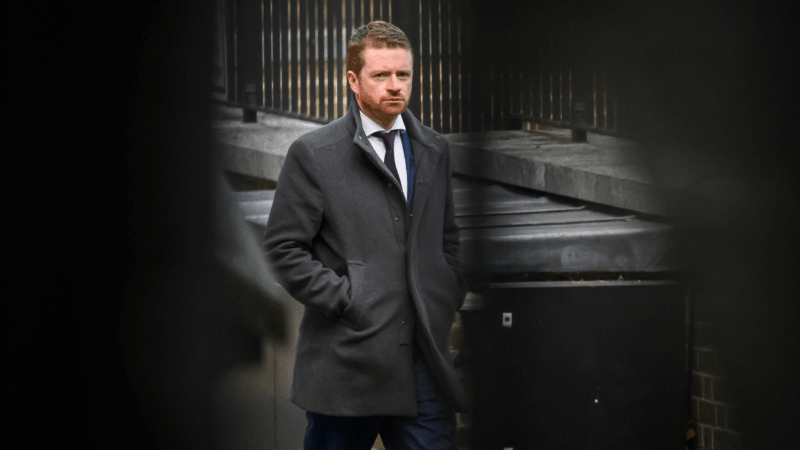
U.K. leader’s chief of staff quits over hiring of Epstein friend as U.S. ambassador
British Prime Minister Keir Starmer's chief of staff resigned Sunday over the furor surrounding the appointment of Peter Mandelson as U.K. ambassador to the U.S. despite his ties to Jeffrey Epstein.
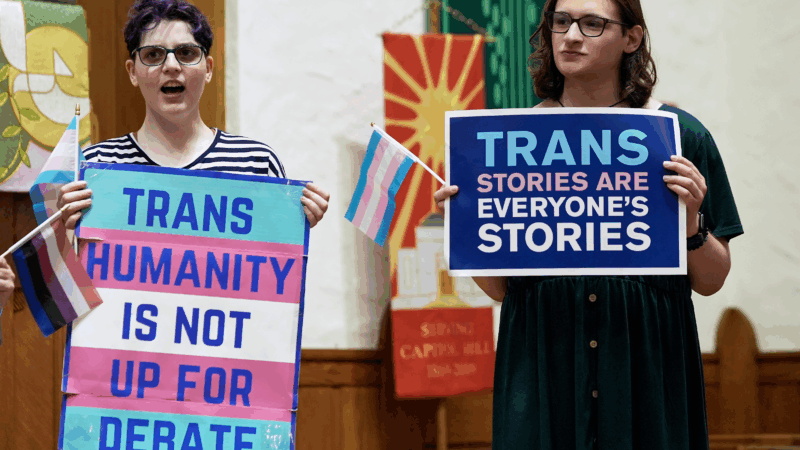
Trump administration lauds plastic surgeons’ statement on trans surgery for minors
A patient who came to regret the top surgery she got as a teen won a $2 million malpractice suit. Then, the American Society of Plastic Surgeons clarified its position that surgery is not recommended for transgender minors.

Sunday Puzzle: -IUM Pandemonium
NPR's Ayesha Rascoe plays the puzzle with KPBS listener Anthony Baio and Weekend Edition Puzzlemaster Will Shortz.
Thailand counts votes in early election with 3 main parties vying for power
Vote counting was underway in Thailand's early general election on Sunday, seen as a three-way race among competing visions of progressive, populist and old-fashioned patronage politics.

US ski star Lindsey Vonn crashes in Olympic downhill race
In an explosive crash near the top of the downhill course in Cortina, Vonn landed a jump perpendicular to the slope and tumbled to a stop shortly below.

For many U.S. Olympic athletes, Italy feels like home turf
Many spent their careers training on the mountains they'll be competing on at the Winter Games. Lindsey Vonn wanted to stage a comeback on these slopes and Jessie Diggins won her first World Cup there.
