


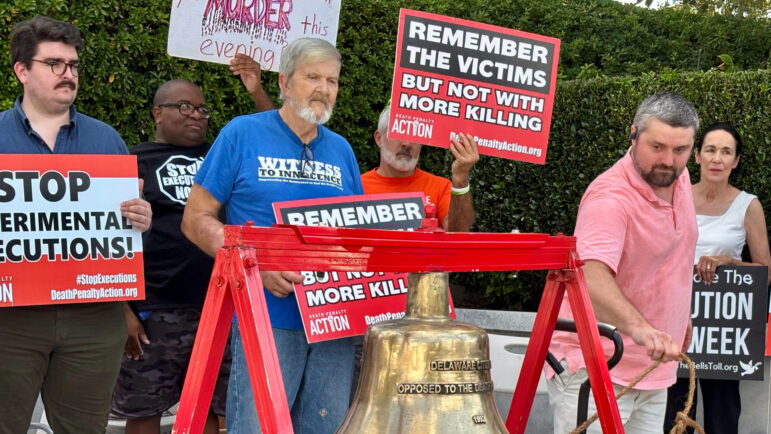
Executions rose dramatically in the U.S. this year, and the Gulf South played a key role, a new report shows.
While Louisiana, Mississippi and Alabama all put people to death, Alabama was in a group of leading states in the nation for both executions and new death sentences, according to a year-end report from the nonprofit Death Penalty Information Center.
Alabama tied Texas and South Carolina for second place in its number of executions, with five. Juries in Alabama decidedto impose more new death sentences — four — than in any other state except California and Florida.
But Alabama also had the most capital trials that reached a verdict of any state — and most ended in a life-without-parole sentence, not a death sentence.
Sentencing numbers are “probably the most meaningful data point that we can look at,” Robin Maher of the Death Penalty Information Center said in a recent interview.
“The number of new death sentences tells us what American juries are thinking about the death penalty,” she said.
Juries typically choose whether a death sentence should be imposed during the “penalty” phase of death penalty trials. Alabama’s system is unusual in that it does not require all jurors to agree on a death sentence, one of just two states where that happens.
The Death Penalty Information Center’s annual report tracks metrics like executions, new death sentences and more to show the state of capital punishment in the U.S.
Louisiana had one execution this year, its first in more than a decade and its first-ever by the controversial nitrogen gas method. Mississippi had two executions, including that of the longest-serving man on its death row.
That added to a year that has seen 47 executions.
The national execution spike in 2025 was largely driven by Florida, the report says, which led the country in executions and set a new state record with 19 state-sponsored killings this year. That’s after much smaller numbers of executions in the last few years.
“Without Florida in the picture, we would have a year that looks very much like the past few years in terms of the total number of executions,” Maher said.
At a news conference earlier this year, Florida Gov. Ron DeSantis said the pandemic “threw a wrench into our corrections,” and a previous slower pace wasn’t intentional. Recent executions were in response to feedback he’d received from victims throughout his terms in office, he said.
“I felt that I owed it to them to make sure that this ran very smoothly and promptly,” DeSantis said.
Looking beyond Florida, both executions and new death sentences were concentrated in a minority of states. Executions took place in 11 states this year.
Legislatively, the report shows that at least 150 death-penalty-related bills were introduced across the country, although the vast majority were not enacted. Those that were included new laws in Louisiana about execution procedures and post-conviction relief.
Polls show public support for the death penalty is in decline, especially among younger Americans. The Gallup polling organization found that support for the death penalty, while still holding a slim majority of approval, is at its lowest levels since 1972.
Maher said she doesn’t think this single outlier year will change the overall downward trajectory of the death penalty. That’s included shrinking numbers of executions since around the millennium and far fewer death sentences.
Many of the people who were executed this year were convicted years ago, Maher said, and would likely not be sentenced to death today.
“Their death sentences occurred at a time when support for the death penalty was much higher, and our attitudes and policies about crime and punishment were very, very different,” she said.
But political forces may influence what happens in the future.
President Donald Trump and his administration have moved to boost the death penalty on both the state and federal levels, and high-profile cases may serve as lightning rods for discourse.
Experts also say the U.S. Supreme Court, which currently has three justices appointed by Trump, is taking a less active role in serving as a backstop in capital cases. An Alabama death row case was argued before the court this month, and it will hear a Mississippi case in the spring.
The Supreme Court denied every request to stay an execution this year, the report said.
This story was produced by the Gulf States Newsroom, a collaboration between Mississippi Public Broadcasting, WBHM in Alabama, WWNO and WRKF in Louisiana and NPR.