


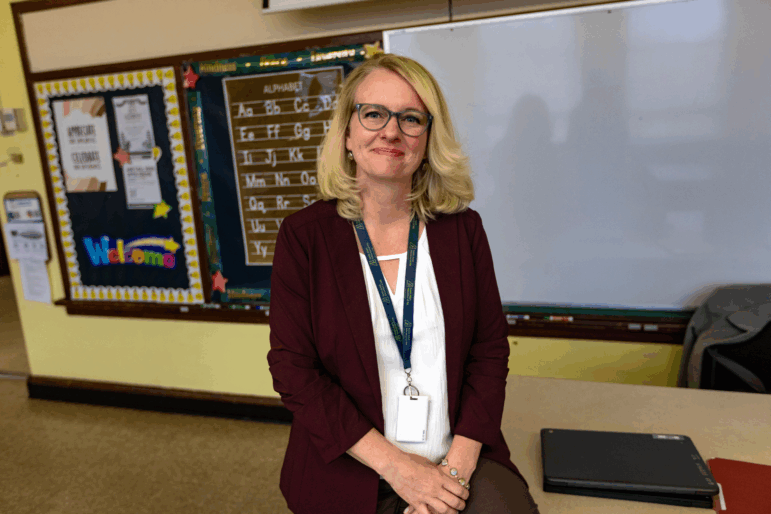
When her doctor died suddenly in August, Tammy MacDonald found herself among the roughly 17% of adults in America without a primary care physician.
MacDonald wanted to find a new doctor right away. She needed refills for her blood pressure medications, and wanted to book a follow-up appointment after a breast cancer scare.
She called 10 primary care practices near her home in Westwood, Mass. None of the doctors, nurse practitioners or physician assistants were taking new patients. A few offices told her that a doctor could see her — in a year and a half, or two years.
“I was just shocked by that, because we live in Boston, and we’re supposed to have this great medical care,” said MacDonald who is 48 and has private health insurance. “I couldn’t get my mind around the fact that we didn’t have any doctors.”
The shortage of primary care providers is a national problem, but it’s particularly acute in Massachusetts. The state’s primary care workforce is shrinking faster than in most other states, according to a recent report.
Some health networks, including the state’s largest hospital chain, Mass General Brigham, are turning to artificial intelligence for solutions.
In September, right when MacDonald was running out of blood pressure medications, Mass General Brigham (MGB) launched its new AI-supported program, Care Connect. MacDonald had received a letter from MGB, telling her no primary care providers in the network were currently taking new patients for in-person care. At the bottom of the letter was a link to Care Connect.
MacDonald downloaded the app and requested a telehealth appointment with a doctor. She then spent about 10 minutes chatting with an AI agent about why she wanted to see a doctor. Afterward, the AI tool sent a summary of the chat to a primary care doctor who could see MacDonald by video.
“I think I got an appointment the next day or two days later. It was just such a difference from being told I had to wait two years.”
24/7 convenience for common medical problems
Mass General Brigham says the AI tool can handle patients seeking care for colds, nausea, rashes, sprains and other common urgent care requests — as well as mild to moderate mental health concerns and issues related to chronic diseases. After the patient types in a description of the symptoms or problem, the AI tool sends a doctor a suggested diagnosis and treatment plan.
MGB’s Care Connect employs 12 physicians to work with the AI. They log in remotely from around the U.S., and patients can get help around the clock, seven days a week.
Care Connect is one of many AI-based tools that hospitals, doctors and administrative staff are testing for a range of routine medical tasks that include note-taking, reviewing diagnostic results, billing and ordering supplies.
Proponents argue that these AI programs can help relieve staff burnout and worker shortages by reducing time spent on medical records, referrals and other administrative tasks. There’s an active debate about when and how to use AI to improve diagnoses. Critics worry that AI agents miss important details about overlapping medical conditions.
Critics also point out that AI tools can’t assess whether patients can afford follow-up care, or get to that appointment. They have no insight into family dynamics or caretaking needs, things that primary physicians come to understand through long-term personal relationships.
Since her first foray on the app in September, MacDonald has used Care Connect three more times. Two of those interactions led to an eventual conversation with a remote doctor, but when she went online to book an appointment for travel-related shots, she only interacted with the AI chatbot, before visiting the travel clinic.
MacDonald likes the convenience.
“I don’t have to leave work,” she said. “And I gained some peace of mind, knowing that I have a plan between now and me finding another in-person doctor.”
So while she hunts for that person, MacDonald will stay with Care Connect.
“This is a logical solution in the short term,” MacDonald said. “At the end of the day, it’s the patient who’s feeling the aftermath of all of the bigger things going on in health care.”
Strains on primary care doctors have led to scarcity and burnout
Many factors contribute to the shortage of primary care providers. Many primary care doctors, such as pediatricians, internists, rheumatologists and neurologists, are dissatisfied with their pay; they earn about 30-50% less, on average, than specialists such as surgeons, cardiologists or anesthesiologists.
At the same time, their workload has been increasing for at least 20 years. Primary care doctors often describe days packed with complex patient visits, followed by evenings spent updating medical records and responding to patient messages.
When MacDonald signed onto Care Connect, she was one of 15,000 patients in the Mass General Brigham system without a primary care provider. That number has grown, as primary care doctors have left MGB for rival hospital networks.
Dr. Madhuri Rao, a primary care physician at an MGB health center in Chelsea, Mass., said she’s staying at MGB for now, but she’s grown frustrated with the system’s leaders.
“They don’t make any effort to ease the shortage,” said Rao, who is also part of an effort to unionize MBG’s primary care doctors. “They put their money into specialties. Primary care feels like a peripheral part of the system, when it really should be a central part.”
Earlier this year, Mass General Brigham pledged to spend $400 million over five years on primary care services — though that includes the multiyear contract with Care Connect.
“Care Connect is just one solution among many in this broader strategy to alleviate the primary care capacity crisis,” said Dr. Ron Walls, Mass General Brigham’s chief operating officer, in an emailed statement. “Our investment supports retaining our current physicians as well as recruiting new ones.”
Walls said MGB has increased staffing support for primary care physicians, implemented other AI tools and hired a new executive for primary care. Some of these changes are based on recommendations from their own primary care doctors.
But some of those doctors say they’d like other changes, and salary increases in particular.
Walls would not disclose the exact amount MGB is spending on Care Connect.
Is AI a bridge to better care, or a “Band-Aid”?
Mass General Brigham has rolled out other AI tools, including one that can transcribe a doctor’s in-person conversations with patients. Dr. Madhuri Rao isn’t using that tool. She worries that patient information could be leaked and medical privacy violated, and she doesn’t want her conversations with patients to be used to help develop the next generation of AI medical tools.
“What if they’re just using my interactions with patients to train their AI and boot me out of my job?” she said.
That’s not the goal, said Dr. Helen Ireland, a primary care physician who manages the program for Mass General Brigham. All decisions about patient care are still made by real doctors.
“We are not replacing our in-person primary care,” said Ireland. “It’s still important, and the majority of patients still have in-person primary care.”
But the fear among some primary care doctors at MGB is that Care Connect will gradually erode access to in-person primary care visits. Of the $400 million pledged by MGB for primary care, they want less spent on AI, and more used to attract and increase pay for primary care staffers.
“We’re using [Care Connect] to basically fill a gap,” said Dr. Michael Barnett, an MGB internist who is also involved in the unionizing effort. “That sounds like a Band-Aid for a broken system to me.”
Plan to expand AI tools, with a focus on urgent care
As of mid-December, the Care Connect doctors were each seeing 40 to 50 patients a day. By February, the MGB network plans to make Care Connect available to all Massachusetts and New Hampshire residents who have health insurance, and will hire more doctors to staff the program as needed.
Patients can use the program like an urgent care service, said Ireland. Patients can also decide to make one of the remote doctors their permanent primary care provider.
“Some patients want in-person care,” said Ireland. “But I do believe there’s a subset of patients who will appreciate the 24-hour, seven-day a week model and choose to be a part of this.”
Care Connect isn’t for patients who need emergency care or a physical exam, Ireland said. And patients who need tests or imaging are referred to the network’s clinics or labs.
But the remote doctors can manage some of the same routine issues that all primary care doctors do, Ireland said, including moderate respiratory infections, allergies and chronic conditions like diabetes, high cholesterol and depression.
For Dr. Steven Lin, that list should only include immediate, not ongoing, health problems. Lin is chief of primary care at Stanford University School of Medicine and founded Stanford’s Healthcare AI Applied Research Team.
“In its current state, the safest use of this tool is for more urgent care issues,” Lin said, “your upper respiratory tract infections, your urinary tract infections, your musculoskeletal injuries, your rashes.”
For patients with multiple chronic conditions such as high blood pressure and diabetes — or for patients with especially serious conditions like heart disease or cancer — Lin said nothing beats a human who sees you regularly.
Still, Lin agrees that the chat summary generated after an AI encounter can help a physician be more efficient. For patients, Lin understands the practical appeal of a virtual option.
“I would rather these patients get care, if that care can be safe,” he said, “than not get care at all.”
The company that developed the AI platform for Care Connect, K Health, contends the program is delivering safe, effective care to patients with complex, chronic ailments — many of whom have no other option besides a hospital emergency room.
“ America’s got a big problem with health care, issues with cost, quality and access,” said Allon Bloch, the company’s CEO. “To solve it, you need to start with primary care, and you have to use technology and AI.”
In addition to Mass General Brigham, K Health partners with five other health networks, including the highly ranked Mayo Clinic and California-based Cedars-Sinai Medical Center.
In a small and limited study funded by K Health, Cedars-Sinai researchers compared several hundred diagnosis and treatment recommendations made by AI to those made by physicians.
The researchers found the AI to be slightly better at identifying “critical red flags” and recommending care based on clinical guidelines, though the physicians were better at adjusting their treatment recommendations as they spoke more with the patient.
This story comes from NPR’s health reporting partnership with WBUR and KFF Health News.