


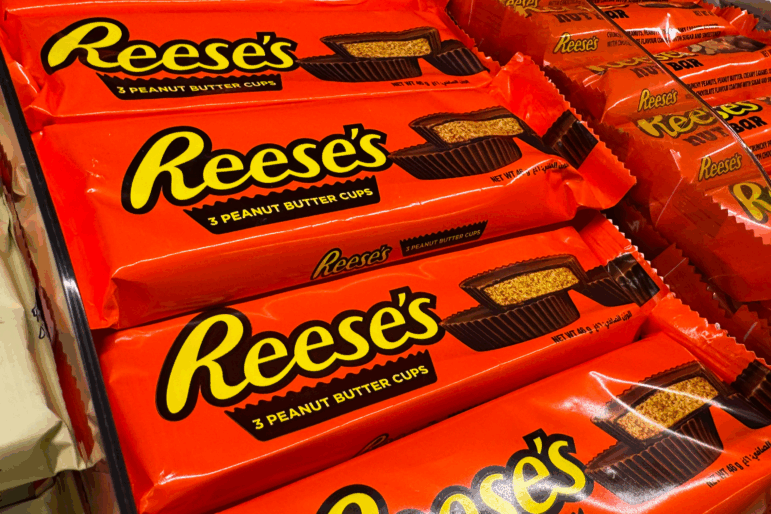
A few years back, the Planet Money newsletter spotted a trend of companies skimping on the quality of their goods and services in response to inflationary pressures, and we coined a new word to describe it: skimpflation. Well, the concept has been getting some renewed attention due to a chocolatey but not-so-sweet story.
Last month, as Valentine’s Day approached, Brad Reese bought a bag of Reese’s Mini Hearts. And his big heart was broken after he realized those little hearts weren’t made with the classic combo of milk chocolate and peanut butter that Reese’s is known for.
Instead, Reese learned, these mini hearts were made with “chocolate candy” and “peanut butter creme,” cheaper concoctions that he felt were far inferior to the real deal.
“It was not edible,” Reese told The Associated Press. “You have to understand. I used to eat a Reese’s product every day. This is very devastating for me.”
Disgusted, Brad Reese threw the whole bag of candy in the trash. And he launched a campaign against The Hershey Company, the owner of Reese’s brand. Ever since, the company’s executives have had a reason to eat their feelings (with, presumably, heaps of junk food at their disposal).
It’d be one thing if Reese was just some random person. But Reese is the grandson of H.B. Reese, who created Reese’s Peanut Butter Cups back in 1928. The Reese family sold their company to The Hershey Company way back in 1963, more than a half century ago. But the iconic candy still bears Brad Reese’s family name, and Reese clearly cares a lot about the brand. He is sometimes photographed wearing bright orange shirts with the Reese’s logo on his chest.


On Valentine’s Day, this scion of the chocolate, peanut-butter dynasty published an open letter on social media to a Hershey’s executive, and, given the source, it ignited a firestorm of media coverage.
“My grandfather, H. B. Reese (who invented Reese’s), built Reese’s on a simple, enduring architecture: milk chocolate + peanut butter. Not a flavor idea. Not a marketing construct. A real, tangible product identity that consumers have trusted for a century,” Reese wrote. “But today, Reese’s identity is being rewritten, not by storytellers, but by formulation decisions that replace milk chocolate with compound coatings and peanut butter with peanut‑butter‑style crèmes across multiple Reese’s products.”
In other words, Brad Reese is accusing The Hershey Company of skimpflation. Skimpflation is when, instead of simply raising prices, companies skimp on the quality of their goods or services to save money — and hope that consumers either don’t notice or don’t care.
Well, Brad Reese has clearly noticed and cares that some of Reese’s products are jettisoning the classic formulation. And he’s now, you could say, skimpshaming the company.
In addition to publishing his open letter and making media appearances, Reese has revamped his personal website. It now says “Brad Reese, Protecting Reese’s Brand Integrity” in big letters at the top of his landing page. And it has an image of an orange baseball cap that says, “Make Reese’s Great Again.”
So why would Hershey’s adopt this sort of business practice? What is the company’s response to Reese’s allegations? And what should we do about skimpflation more generally?
What’s causing chocolate skimpflation
Over the last few years, chocolate companies have been getting rocked by supply chain disruptions, labor challenges, tariffs, and price volatility.
About 70% of cocoa, the crucial raw ingredient to make chocolate, comes from West Africa. And oscillating periods of damaging rainfall and extreme drought — which some researchers blame on climate change — have been disrupting cocoa production in the region. Largely due to these disruptions and financial speculation around them, in late 2024, the price of cocoa hit record highs.
To boot, the Trump administration levied high tariffs on cocoa-producing nations, and that affected companies like Hershey’s.
Over the last year, these cost pressures on America’s chocolate manufacturers have subsided. In November, the Trump Administration, trying to address concerns about affordability, exempted cocoa from their high tariffs, much to Hershey’s relief. And the production problems in West Africa seem to have at least been partially resolved. Since May 2025, the price of cocoa has fallen almost 80%.
But, given all the price volatility and the length of time it takes to make and market products, the pipeline of new candies likely reflects decisions made months or maybe even years ago, and it makes sense why many candy companies have released products that skimp on chocolate.
The federal government has regulations that strictly define what can be labeled and marketed as “milk chocolate.” That definition includes the requirement that these products must include at least 10% “chocolate liquor,” a thick, dark, non-alcoholic paste made from ground cocoa beans.
An investigation by Claire Brown at The New York Times found back in October that chocolate companies — including Hershey’s, with Almond Joy, Mr. Goodbar, and Rolo — had been removing the words “milk chocolate” on wrappers of their products and replacing them with “chocolate candy.” These products seem to no longer fit the bill of the government-regulated definition.
We reached out to Hershey’s to get their response to Reese’s allegations, and they provided a statement that assured us that, when it comes to their “iconic” Reese’s Peanut Butter Cups, they are “made the same way they always have been, starting with roasting fresh peanuts to make our unique, one-of-a-kind peanut butter that is then combined with milk chocolate.” Indeed, Reese’s Peanut Butter Cups are still labeled as such, at least in the United States.
But Hershey’s statement — and a cursory look at some of Reese’s other products — indicates that a slew of candies using the Reese’s brand do not have ingredients that meet the federal definition of “milk chocolate” and/or “peanut butter.”
“As we’ve grown and expanded the Reese’s product line, we make product recipe adjustments that allow us to make new shapes, sizes and innovations that Reese’s fans have come to love and ask for,” the Hershey’s statement reads. “As innovations and forms change over time, those updates are always reflected in on-pack ingredient information, which is the most accurate and up-to-date source for consumers.”
In other words, The Hershey Company is selling their candy’s lack of milk chocolate and peanut butter as innovations, not skimpflation.
Is skimpflation on the rise?
When companies face cost pressures, they often have to make decisions on how to stay profitable. Their options include raising prices, as is the case with standard inflation. They can keep prices the same while shrinking the amount of stuff they provide in packages, which is known as shrinkflation. Or they can cut costs. One way to do that is to change ingredients and potentially degrade a product’s quality, as is the case with what we’ve dubbed skimpflation.
Lindsay Owens is the executive Director of the Groundwork Collaborative, an economic think tank, who has testified before Congress about these corporate tactics.
In 2024, Owens did a study and, she says, she found that “shrinkflation accounted for as much as 10% of total inflation” in certain product categories, including paper towels, toilet paper, and certain types of snacks.
It’s much harder to systematically quantify the prevalence of skimpflation because it’s about quality, not quantity. But, she suggests, it’s also become a popular tactic to deal with rising costs while maintaining or increasing profitability.
Owens argues skimpflation can be problematic for reasons beyond just a deterioration of quality. “In the case of food, often when we’re seeing reformulations and a move to cheaper products, these are also more processed products, and those have real health implications for Americans who are consuming these items,” she says.
Economists have one of those jargony terms that is relevant to this phenomenon. It’s called “asymmetric information.” The basic idea is that markets can have problems when buyers or sellers don’t have complete information about what they’re buying or selling. Asymmetric information is one justification for government interventions to ensure markets operate in the public interest.
In the case of food and candy, the federal government has already done something about the problem of asymmetric information, with, for example, The Fair Packaging and Labeling Act and other similar laws. As we’ve already mentioned, federal law requires candy and other companies to disclose their ingredients and that they can only label their products with monikers like “milk chocolate” if they meet strictly defined criteria.
As a result, consumers have at their disposal, often on the front of the label, the information they need to know whether confections they’re thinking of buying meet the federal definition of chocolate or not.
That said, it’s easy to miss a subtle change on labels, and terms like “chocolate candy,” as opposed to “milk chocolate,” can be a bit misleading if you don’t know what that actually means.
Owens said federal authorities should take a closer look at issues like these, and perhaps update label practices to ensure that consumers have the transparency they need.
And, of course, it’s not just up to the government to do something about skimpflation. Journalists, influencers, and skimpshamers like Brad Reese can do something too. Their work in getting the word out could maybe make corporations think twice about skimping on their ingredients.