


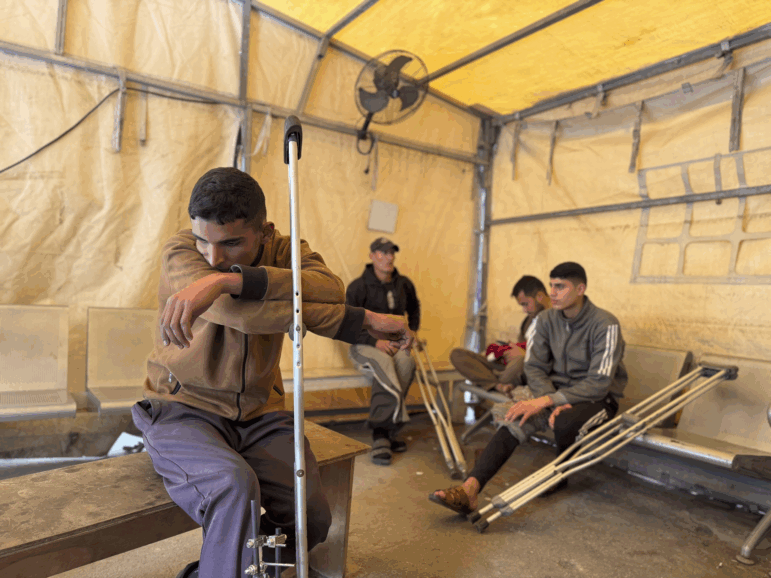
GAZA CITY, Gaza Strip — Mohammed Ibrahim wants to run and play soccer again, but the 14-year-old has had three surgeries since an accident this summer when he was run over as he tried to grab food off an aid truck for his starving family.
A nurse at this Gaza City clinic changes the gauze on his right leg. He winces in pain.
“Focus with us and calm your mind,” she tells him. “You will be just fine.”
“It hurts,” the boy whimpers. Unable to fight back tears, he bursts out: “I can’t! I can’t!”
This clinic is run by Doctors Without Borders, also known by its French initials MSF, an international aid group that provides lifesaving care in war zones around the world. But this clinic and MSF’s 19 other health care facilities and medical points across Gaza are facing massive pressure, and some may even have to shut down.
Israel banned MSF and dozens of international aid organizations, preventing them from bringing in aid or international staff to Gaza and the occupied West Bank under new security and transparency rules that came into effect on Jan. 1.
“It’s a catastrophe. An absolute catastrophe,” Ibrahim’s mom, Neama Abu Ghanim, says of Israel’s decision.
She tells NPR that before coming to this MSF clinic, her son spent months unable to sleep from pain, despite seeking treatment in some of Gaza’s still partially functioning hospitals. Gaza’s health system was shattered during two years of war.
“When I came here, they helped him with medicine to sleep for even just a few hours at night, which helped me so much,” she says.


According to Gaza’s Health Ministry, in addition to tens of thousands of people killed, more than 171,000 Palestinians were wounded in Israeli attacks in the war. Many of them turn to clinics, like the ones run by MSF, for treatment.
At MSF’s clinic in Gaza City last week, NPR saw doctors treating an 8-year-old girl whose arm was severely burned in an Israeli airstrike, encouraging her to move her wrist where scar tissue had formed. Another young girl was in a room with colorful building blocks for mental health support. A young man rode a stationary bike for physical therapy. Others were pushed on wheelchairs for checkups.
The aid group says it treated around 1 million people in Gaza last year, or half the population.
International staff and aid are barred
The Israeli decision to bar MSF and other aid groups means they can no longer bring international staff or aid into Gaza or the West Bank. They will have to rely solely on exhausted local staff, working with dwindling supplies and no international specialist expertise.
MSF told NPR it currently has 1,100 employees in Gaza, about 50 of whom are international staff. The group says every request to Israel to bring in aid and rotate new staff into Gaza has been refused in recent days.
Loay Harb, a Palestinian nurse at MSF’s clinic in Gaza City, says he sees complicated cases every day, many of them requiring multiple operations and months of treatment.
“I am trying to provide the best care to patients because I know they don’t have any access to this kind of care elsewhere,” Harb says, adding there’s a waitlist of people trying to get in.
Israel says Gaza isn’t dependent on MSF’s work
Israel says it is banning around 40 international aid organizations from entering Gaza and the West Bank because they failed to meet new security and transparency standards.
A partial list of the banned aid groups was made public by Israel last month, when the decision was announced.
In addition to MSF, the groups include Oxfam, which has worked on desalination and clean water, the Norwegian Refugee Council, which has overseen tents and shelter supplies, Mercy Corps, which has distributed food and basic aid, Save the Children, which has assisted with maternal care, and Rahma Worldwide, which had brought doctors from the U.S. to volunteer in Gaza’s hospitals
The Israeli government says these organizations failed to provide full disclosure of the identities and roles of their employees. This requirement was instated after the deadly Oct. 7 Hamas-led attack on Israel in 2023. Israel says its new rules are intended to prevent the exploitation of aid by Hamas.
More than 50 international aid groups responded in an open letter, saying they cannot provide personal data of their staff to a party to the conflict.
They also noted that more than 400 aid workers were killed in Israeli attacks on Gaza in the past two years of war.
MSF’s emergency coordinator in Jerusalem, Pascal Coissard, told NPR that aid organizations have tried for months to understand what this personal data on local staff would be used for, but received no clear answers.
“We have expressed our concerns to the Israeli authorities about sharing the staff list because it is unclear, still for us, what they are going to use it for,” she said.
Israel says aid groups were “given a full 10 months to regularize their licenses… and failed to do so.”

MSF has been operating in the Palestinian territories since 1989. Fifteen of its staff were killed in Israeli attacks in Gaza during the war. Its clinics have also been bombed.
Israel accused two of the killed MSF employees of having ties with militant groups, saying one was a sniper. MSF denies the allegations, saying it would never knowingly employ anyone involved in militant activities. It said Israel’s ban is a violation of international humanitarian law and aimed at preventing access to aid.
Israel’s ministry overseeing the de-registration of MSF said the group had “abandoned neutrality” and that “humanitarian assistance in Gaza does not depend on the organization’s presence.”
Countries and U.N. agencies call on Israel to reverse the ban
In a joint statement, every major U.N. agency working in Gaza called on Israel to reverse the ban on international aid groups, warning this will harm the little progress made in the ceasefire, which began in October. They say it will also further harm efforts to assist people through another winter in makeshift tents drenched in rain. Several children have died of hypothermia in recent weeks, according to Gaza’s health ministry and hospital records.
Ten countries, including the U.K., France and Canada, called Israel’s ban “unacceptable.” They said a third of Gaza’s healthcare facilities are run by international aid groups.
Israel says the ban on these dozens of aid groups will have no harm on aid entering Gaza.
“Attempts by organizations to portray the humanitarian system in Gaza as dependent on their personnel are disconnected from the reality on the ground,” according to COGAT, Israel’s military arm overseeing the entry of goods into Gaza.
International staff provided accounts of Israeli attacks
Many of the aid groups now banned had also provided critical accounts of what was happening in Gaza during the war as Israel continues to bar international press from independent access.
Under Israel’s new registration requirements, aid groups’ licenses can be revoked if they engage in “delegitimization activities against Israel, legal persecution of IDF [Israeli] soldiers, Holocaust denial, or denial of the October 7 atrocities.”
Many of these aid groups have published detailed reports on aid restrictions by Israel, and their international staff and medics have provided first-hand accounts from Gaza. These have been widely quoted by the media and could be used against Israel in international courts as it fights genocide and war crimes charges.

In September, 20 aid groups signed a letter after a U.N. commission determined Israel had committed genocide in Gaza, which Israel denies, supporting the findings and saying their staff have seen traumatized children, people with lost limbs and families starving.
At least 15 of the 20 groups that signed the letter are among those now banned by Israel.
MSF also published a detailed report on what it called the “orchestrated killing” of Palestinians by Israeli forces while trying to get food from U.S.- and Israeli-backed sites in Gaza. The report, published at the height of what experts said was a famine, drew on medical data and testimonies from MSF’s field clinic near a Gaza Humanitarian Foundation site, calling it a “death trap.”
MSF said in a statement after Israel’s ban was announced that if the descriptions of what its teams see with their own eyes in Gaza are unpalatable to some, “the fault lies with those committing these atrocities, not with those who speak of them.”
Batrawy reported from Dubai, United Arab Emirates.
Transcript:
SCOTT DETROW, HOST:
U.N. agencies in 10 countries, including the U.K., France and Canada, are urging Israel to reverse a ban on well-recognized international aid groups from entering Gaza. Among the groups now banned is Doctors Without Borders, which provides lifesaving care to people in war zones around the world. NPR reporters Aya Batrawy and Anas Baba zoom in on the group’s work in Gaza.
UNIDENTIFIED CHILD: (Shouting in non-English language).
AYA BATRAWY, BYLINE: There’s a ceasefire in Gaza now, but every household and family here has lost people, and everywhere one looks are the wounded. This Doctors Without Borders clinic in Gaza City offers something most others can’t, specialized wound care.
NOUR ZINOU: (Crying) Momma.
AYA BATRAWY: The medics here are treating 8-year-old Nour Zinou for burns from an Israeli airstrike three months ago. Doctors Without Borders, or MSF, has been operating in the Palestinian territories since 1989, but now it’s being banned by Israel, along with around 40 other international aid groups. Israel says they failed to meet new security and transparency standards.
UNIDENTIFIED DOCTOR: (Non-English language spoken).
AYA BATRAWY: The MSF doctor at this clinic tries to coax Zinou, in her red tracksuit and ponytail, to move her wrist, where the skin is raw in some parts and forming thick tissue scar in others.
UNIDENTIFIED DOCTOR: (Non-English language spoken).
AYA BATRAWY: Gaza’s health system was decimated in the war. Clinics like this, run by international aid groups, are helping keep Gaza alive. MSF alone says it treated around a million people in 2025. That’s half the population. Hunter McGovern is a project coordinator for MSF in Gaza.
HUNTER MCGOVERN: There’s a huge waiting list of people that need care outside of the Strip, and they don’t have the ability to leave and go access it. Our operation is already overstressed.
AYA BATRAWY: He says their work includes providing clean drinking water, maternity services and physiotherapy. All of it is at risk now. Israel’s decision, which came into effect January 1, bars MSF from bringing in aid or international staff to Gaza as well as the occupied West Bank, which means relying entirely on local staff. Israel says the new rules that led to aid groups losing their registration to operate are aimed at preventing Hamas from infiltrating these organizations. Israel says some local Palestinian MSF staffers have ties to Hamas and one was a sniper. Ishaq al-Bardawil, a local administrator with MSF who was wounded in an Israeli attack on this very clinic, says the organization doesn’t take sides in the war.
ISHAQ AL-BARDAWIL: (Non-English language spoken).
AYA BATRAWY: In a statement, MSF says it would never knowingly employ anyone involved in military activities and that accusations without substantiated evidence endanger the lives of humanitarian workers. Here’s McGovern again.
MCGOVERN: We’re an independent, neutral organization who just tries to provide health care to people. So we would all love to know why we’re being halted.
AYA BATRAWY: Israel’s new rules for aid groups require they provide information on their funding and detailed lists of staff. But aid groups say this could endanger their employees and that Israel has not said how this data would be used. MSF has had 15 of its staff killed in Gaza. There are among some 400 aid workers killed in Israeli attacks in the war, according to the U.N. Israel says its new rules also ban aid groups if they’ve engaged in, quote, “delegitimization activities against the state” or in legal persecution of Israeli soldiers. Groups now banned, like Oxfam and Save the Children, have been publicly critical of Israel’s restrictions on aid, and their accounts could be cited against Israel in international courts. MSF has also documented through its field clinics Israeli army killings of Palestinians seeking food.
At MSF’s clinic in Gaza City, a 14-year-old boy winces in pain as his leg’s examined following surgery. Mohammed Ibrahim was run over by a truck when he tried to grab a sack of flour during what experts said was a famine in north Gaza this summer. NPR’s Anas Baba explains.
ANAS BABA, BYLINE: He’s frustrated. He wants to run. And now he’s being treated.
MOHAMMED IBRAHIM: (Non-English language spoken).
AYA BATRAWY: McGovern, who’s in Gaza now but won’t be allowed back, says children need years of treatment.
MCGOVERN: You know, children missing limbs, children with wicked, life-altering injuries. And it’s going to be many lifetimes before this is in the past.
AYA BATRAWY: Aya Batrawy, NPR News, Dubai, with Anas Baba in Gaza City.
(SOUNDBITE OF EMOTIONAL ORANGES SONG, “TALK ABOUT US (FEAT. ISAIAH FALLS”)