



EUREKA, Calif., and ZHANGBEI COUNTY, China– Twenty miles off the misty northern coast of California, off of Humboldt Bay, there’s a plan to build offshore wind turbines to power more than two million American homes.
The marine terminal that will assemble the turbines was supposed to be shovel-ready as soon as 2026, says Chris Mikkelsen, executive director of the Humboldt Bay Harbor District. That’s no longer realistic, he says, in part because the Trump administration recently canceled more than $426 million in federal grants for the port. The project now needs to find new sources of money.
“Now we’ve been on pause since we got the news in August, we’ve been pencils down,” Mikkelsen says. “It very much contributed to the delay.”
The Trump administration is reversing federal support for renewable energy, which it labels as risky and unreliable. But across the Pacific ocean, America’s biggest competitor, China, is heading in the opposite direction, says Li Shuo, director of China Climate Hub at the Asia Society.
China now dominates the global renewables sector. In the first half of this year, China built more solar than the rest of the world combined. China accounts for 74% of all large scale solar and wind under construction, according to the nonprofit Global Energy Monitor. The U.S. accounts for 5.9%. “It couldn’t be a stronger contrast between the two countries,” Li says.
China’s bet on the green transition is paying off. More than a quarter of China’s economic growth in 2024 came from wind, solar and battery technologies, according to the Centre for Research on Energy and Clean Air, a nonprofit. Energy experts say it’s too early to know the full impact of the Trump administration’s anti-renewable policies, but in the first half of 2025, U.S. renewable investment fell by 36%.
In an emailed statement, White House spokesperson Taylor Rogers writes, “Rolling back the unpopular Green Energy Scam and unleashing energy sources like natural gas, nuclear, and beautiful, clean coal are commonsense policies that will increase base load power, strengthen grid stability, and lower energy costs.”
Large solar and wind projects provide more cost-competitive energy than natural gas, nuclear, and coal projects, according to financial services firm Lazard.
By backtracking on renewable energy investments, the U.S. federal government is forfeiting a key driver of economic growth, says Jeremy Wallace, professor of China studies at Johns Hopkins University. The U.S. is also now on the sidelines of the international fight to slow global warming. “What America does,” he says, “is not the main part of the story. It’s a cute side character.”
“China’s efforts,” Wallace says, “are the main story for fighting climate change.”


In China, betting on renewables as a driver of growth
In China’s Zhangbei County, between Beijing and the edge of the Mongolian plateau, wind turbines’ massive blades whoosh, turning in giant circles. On the roads, trucks carry turbine blades the length of two basketball courts.
The arid and sparsely inhabited high plains and deserts of China’s northwest are home to much of China’s renewable energy resources.
China’s renewable industry growth didn’t happen overnight. Two decades ago, authorities in Beijing began making strategic decisions for a more sustainable model of economic growth, including building a supply chain for renewable energy technologies, and key investments in grid infrastructure.
In the past, China’s economic growth came at the cost of air pollution from burning fossil fuels. No longer, says Qin Haiyan, vice president of the World Wind Energy Association.
“Developing the economy and reducing carbon emissions to address climate change are no longer contradictory,” Qin says.
Investments in a robust network of supply chains have made renewables not just plentiful, but cheap, Li says. China is now exporting turbines, solar panels and batteries around the world, from Pakistan to Nigeria to Brazil.
Renewable technologies, both local and exports abroad, are a bright spot in China’s slowing economy, especially its slumping real estate sector.
“ People who used to be swinging hammers building commercial real estate are now swinging hammers installing solar panels,” says David Fishman, principal at the Lantau Group, a consulting firm in Shanghai. “Of course you’d double, triple down on that.”
Li attributes China’s success in renewable energy to “very consistent, predictable, and strong policy support” over multiple decades. The U.S., Li says, is demonstrating the exact opposite of consistency.

The U.S. dismantles federal support for renewables
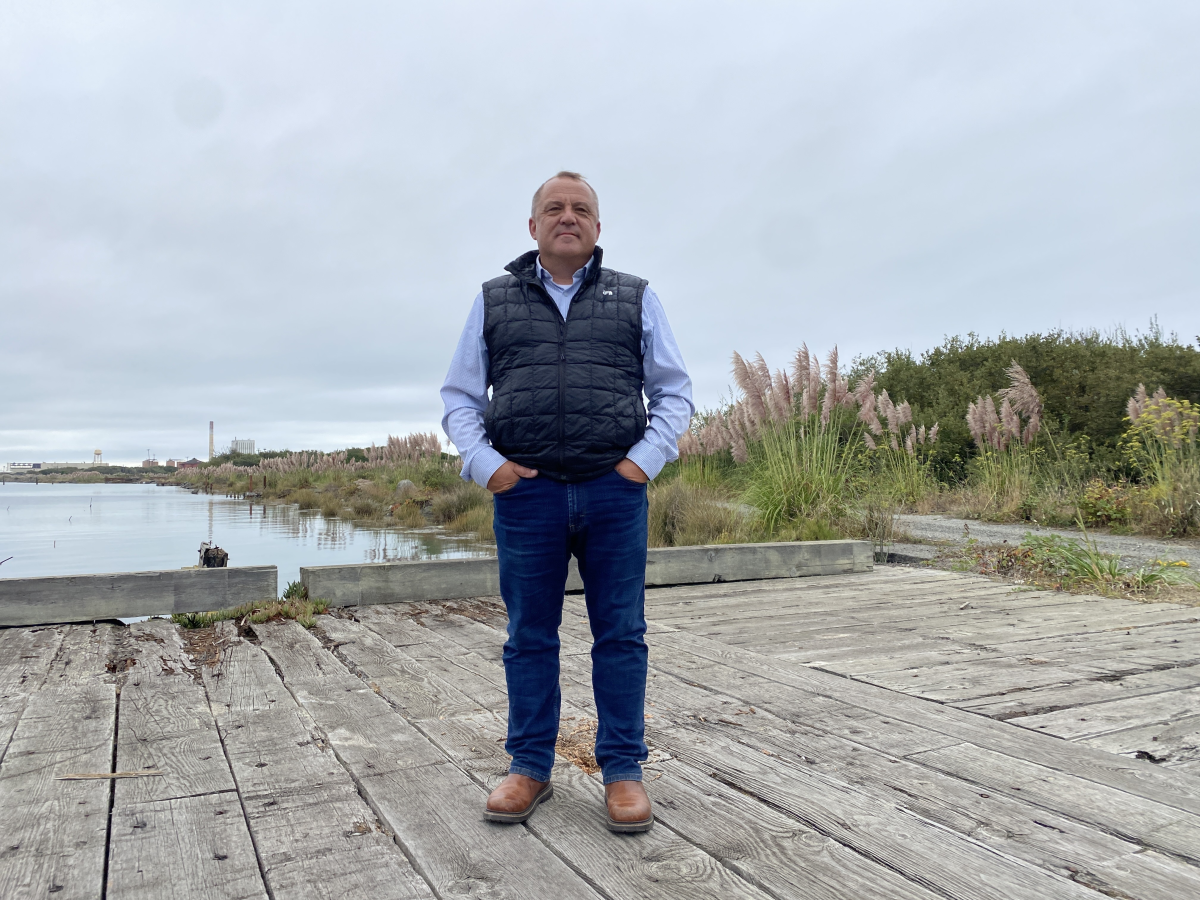
On the coast of Eureka, Mikkelsen drives an old police cruiser past wooden houses and pine trees with hanging moss. “It’s just an old seaside town,” he says looking out the window.
The planned port, where the wind turbines will get constructed before being brought offshore, is on the site of an abandoned pulp mill. Piles of wooden logs are still visible through the rusted fences. “The remnants of what once was,” Mikkelsen says.
Mikkelsen says the wind project and port will “change the economic viability of our community.” His green eyes start to well up. “My voice gets a little shaky ’cause it’s gonna make a better opportunity for our kids.”
Mikkelsen says he’s still confused as to why the Trump administration decided to terminate the grants for the marine terminal. The combined wind and terminal projects aim to create as many as 270 long-term local jobs.
The White House press office did not respond directly to questions about the cancellation of grants for the marine terminal. Spokesperson Rogers said in her emailed statement, “President Trump’s energy dominance agenda is critical to putting an end to Joe Biden’s inflation crisis and economic disaster.”
Mikkelsen says the administration that was recently elected, “really ran on a platform that we’re gonna build back America. That we’re gonna create jobs in rural America. Good, skilled, trained, high-paying jobs.”
Mikkelsen gestures around him at the pulp mill and the creaky dock under his feet. “There’s no better place,” he says.

“Standing in the way”
For the past eleven months the Trump administration has been dismantling federal support for wind and solar industries. In 2022, the Biden administration was able to push through a climate law that helped bolster manufacturing for the renewables sector, and extended federal tax credits for wind and solar. The new GOP spending law passed this year ends those tax incentives years sooner than originally scheduled, throwing thousands of projects across the U.S. into doubt. The Trump administration also canceled more than $13 billion in funds for green energy projects and tried to halt offshore wind projects already under construction.
Trump is undercutting a growing U.S. renewable industry, says Jesse Jenkins, a professor of engineering at Princeton University and adviser to the Biden administration on the 2022 climate law. In 2025, more than half of newly planned electricity capacity will come from solar and wind, according to the Energy Information Administration, a federal agency. A report from the business group E2 finds that last year, clean energy jobs grew three times faster than those in the rest of the workforce.
Jenkins and his team calculated the impact of the loss of federal tax incentives on the renewable energy sector. They estimate that between now and 2035, the U.S. will see far less solar and wind, the equivalent of “more than the entire contribution of all of our nuclear plants or coal plants,” Jenkins says.
“We would’ve taken two steps forward under the prior [climate] law. Now we might take one step forward and what the Trump administration is doing is standing in the way of even that step,” Jenkins says.
“The best hope for global climate progress”
China and the U.S. are still the world’s two largest polluters driving global warming. But because of solar panels, wind turbines and batteries, their stories are now diverging.
Jenkins says it’s still hard to know what Trump administration anti-renewable energy policies means for America’s planet-heating pollution. In addition to rolling back renewable energy investments, the U.S. is looking to eliminate key pollution control laws, which will affect pollution standards for cars, trucks, power plants, and fossil fuel production.
China’s emissions have been flat or falling for 18 months, the first time energy demand growth hasn’t resulted in more emissions, says Lauri Myllyvirta, lead analyst at the nonprofit Centre for Research on Energy and Clean Air.
China’s emission reductions largely come down to the expansion of solar and wind, which are now cheaper than coal and gas. While China continues to build new coal power plants, it operates them mostly as backup, when hydropower isn’t working or electricity demand is high, Myllyvirta says.
Because of global Chinese exports of EVs, solar, and wind components, China is helping other countries reduce their own planet-heating emissions, too.
“ I would argue the Chinese renewable energy story is probably the most important storyline to watch for the global climate agenda,” Li says.
“You’ll probably see China as the best hope for global climate progress over the coming years.”
NPR’s Julia Simon reported from Eureka, Calif., NPR’s Anthony Kuhn reported from Zhangbei County and Beijing, and NPR’s Cao Aowen contributed to this report in Zhangbei County and Beijing
Transcript:
A MARTÍNEZ, HOST:
World leaders have gathered in Brazil for the U.N. Climate Conference. The U.S. is not there, but China is. When it comes to energy transition, the U.S. and China couldn’t be on more different paths. China is moving away from fossil fuels while the U.S. is doubling down. Experts say this will have consequences for the climate and these countries’ economies. NPR sent two correspondents to opposite sides of the Pacific to learn more. We begin with NPR’s Julia Simon in Eureka, California.
JULIA SIMON, BYLINE: In far northern California, Chris Mikkelsen drives an old police cruiser past little wooden houses.
Pine trees with moss just, like, hanging off of them.
CHRIS MIKKELSEN: It’s just an old seaside town.
SIMON: Mikkelsen is the executive director of the Humboldt Bay Harbor District, which plans to assemble wind turbines for a massive new offshore wind project. About 20 miles off this misty coast, two companies – American Vineyard Offshore and German RWE – plan to build turbines to power more than 2 million homes. Mikkelsen says the project aims to make about 270 long-term local jobs.
MIKKELSEN: It’s going to, you know, change the economic viability of our community. And I get a little – my voice gets a little shaky ’cause it’s going to make a better opportunity for our kids.
SIMON: Yeah.
MIKKELSEN: That’s pretty important.
SIMON: The new terminal was supposed to be shovel-ready as soon as 2026, Mikkelsen says. That’s no longer realistic, in part because the Trump administration recently canceled more than $426 million in federal grants for the project. Mikkelsen says it’s been pencils down since then as they try to find new sources of money. This is one of dozens of actions this administration has taken to starve the renewable energy industry of federal support from canceling tax credits years early to issuing stop-work orders.
Amanda Levin at the nonprofit Natural Resources Defense Council says the U.S. renewable industry had been growing.
AMANDA LEVIN: For the first time last year, wind and solar produced more electricity than coal. Things were headed in the right direction, but this really just takes the wind out of their sails.
SIMON: The Trump administration is reversing support for renewables, which it incorrectly labels as risky and unreliable. But across the Pacific Ocean, America’s biggest competitor – China – thinks otherwise. Let’s throw the mic 5,000 miles to NPR’s Anthony Kuhn, who’s there.
ANTHONY KUHN, BYLINE: You are right, Julia. Here in China, renewable isn’t a dirty word. China’s leadership has made strategic choices to include renewables in its energy mix. We’re in China’s Zhangbei region, which is in between the capital Beijing and the edge of the Mongolian Plateau. The area is rich in wind resources, and it’s where a lot of China’s wind and solar capacity is being installed.
(SOUNDBITE OF TURBINE BLADES SPINNING)
KUHN: Turbine blades swoosh past in huge circles. The electricity goes from here to a grid outside Beijing and on to the rest of China. China now dominates the global renewable sector. In the first half of this year, China built more solar than the rest of the world combined. Seventy-four percent of all large-scale wind and solar projects are being built in China. Compare that to the U.S. that’s building 6%. China now has more installed generation capacity from solar and wind than from gas and coal.
It wasn’t always this way. Until recently, China’s economic growth came at the cost of air pollution from burning fossil fuels. But in the last few decades, authorities in Beijing began to consider a sustainable economic growth model, and renewables have been a key part of that, according to Qin Haiyan, director of the parent company of the wind farm we visited and vice president of the World Wind Energy Association.
QIN HAIYAN: (Through interpreter) Developing the economy and reducing carbon emissions to address climate change are now no longer contradictory.
KUHN: And this, according to the Asia Society’s Li Shuo, is the biggest difference between the U.S. and China in climate policy today.
LI SHUO: It couldn’t be a stronger contrast between the two countries.
KUHN: In China, solar and wind are now cheaper than coal and gas. Li Shuo says one of the most dramatic aspects of China’s climate story is not just that they seem to be cutting their climate emissions…
LI: But also, to what extent other parts of the world can also benefit from China’s low-carbon products.
SIMON: So China is now exporting turbines and solar panels and batteries around the world, from Brazil to Nigeria to Pakistan.
KUHN: That’s right, Julia. All the renewables growth, both local and exports, is a bright spot amid China’s slowing economy, especially its slumping real estate sector. David Fishman is a principal at the Lantau Group in Shanghai.
DAVID FISHMAN: People who used to be swinging hammers building commercial real estate are now swinging hammers installing solar panels. And that – well, yes, of course. You double – triple down on that.
(SOUNDBITE OF WIND BLOWING)
SIMON: Back in Eureka, Mikkelsen walks along a creaky dock, an abandoned pulp mill looming behind us. He says he doesn’t understand why the Trump administration would cancel the grants for the terminal supporting the wind project. He says this community has been suffering since 2008 when the pulp mill closed.
MIKKELSEN: Our administration that was recently elected, not only at the presidential level but even some of our Congress and senators, really ran on a platform that we’re going to build back America, that we’re going to create jobs in rural America – good, skilled, trained, you know, high-paying jobs. And there’s no better place. You’re looking around, you’re seeing the remnants of what once was.
SIMON: It is still unclear what the nationwide cuts to renewable energy mean for U.S. climate emissions.
KUHN: But in China, the climate story is more clear, and it’s a rare, encouraging indicator in the global warming story. The growth of renewable energy means that China’s emissions seem to be on track to peak or are nearing their peak, Li Shuo says. And China’s renewable exports mean the country is helping other countries reduce their emissions too.
SIMON: Jeremy Wallace, professor at Johns Hopkins University, says now, at the end of the day…
JEREMY WALLACE: What America does is part of a story, and it is not the main part of the story. It’s a cute side character.
KUHN: China, he says, is now the main character in the story of fighting climate change. Anthony Kuhn, NPR News, Zhangbei County, Hebei Province, China.
SIMON: Julia Simon, NPR News, Eureka, California.
MARTÍNEZ: The Natural Resources Defense Council is one of NPR’s sponsors, and we cover it as we would any other organization.
(SOUNDBITE OF MODEST MOUSE SONG, “BANKRUPT ON SELLING”)