


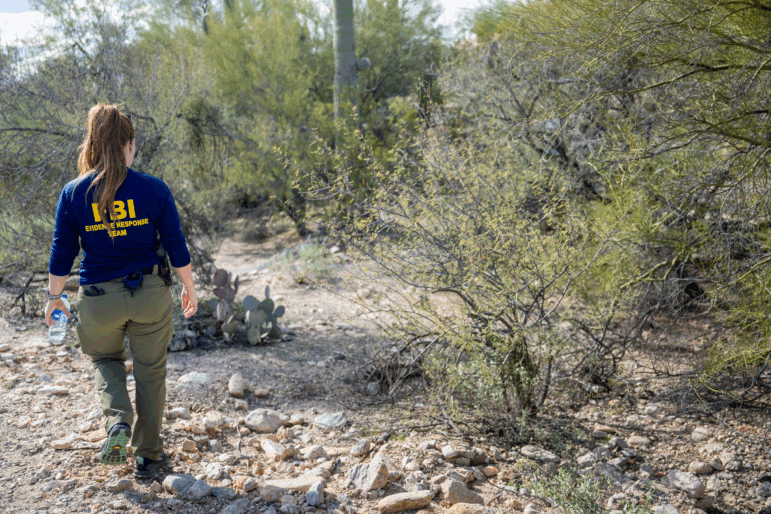
Investigators in Arizona are hoping that DNA found in and around Nancy Guthrie’s house in Tucson could lead them to a suspect — and the missing woman. Guthrie, the 84-year-old mother of Today show co-host Savannah Guthrie, was last seen on Jan. 31.
So far, a key tool — the Combined DNA Index System (CODIS), a federal database of genetic records mainly taken from people suspected or convicted of crimes — has not returned a match for samples that have been tested, according to the Pima County Sheriff’s Department.
But in cases where CODIS can’t help, other DNA tools are available.
“Investigators are currently looking into additional investigative genetic genealogy options for DNA evidence to check for matches,” the sheriff’s department said on Tuesday.
An important option is forensic investigative genetic genealogy (FIGG), which incorporates public genealogy websites with DNA analysis. It has cracked high-profile cold cases such as the Golden State Killer attacks — prompting the National District Attorneys Association to proclaim in late 2023 that FIGG was ushering in a “new era in crime solving.”
That same year, FIGG helped solve a notable case.
“The most obvious one that was recently used was the Bryan Kohberger case in Idaho, where he killed four college students,” says Kathleen Corrado, executive director of the Forensic and National Security Sciences Institute at Syracuse University. That case, she says, showed FIGG “can be used in active investigations.”
Now that includes Nancy Guthrie’s case. Here’s a brief guide to FIGG and other DNA investigative tools that authorities could use as they continue the search for the missing woman:
How forensic investigative genetic genealogy works
“One important thing for the public to understand is that this is not law enforcement going into the direct-to-consumer databases that everybody is buying to get their DNA tested,” says Kelly Knight, a professor of forensic science at George Mason University who formerly worked in state forensic labs.
“This is not a direct search of those databases,” she says, noting that many such companies don’t allow law enforcement to use them, out of privacy concerns.
Genealogy company Ancestry, for instance, says it requires a search warrant or court order before considering a law enforcement request to access its DNA database. In recent years, the company says, it hasn’t received any “valid requests” to do that.
Instead, FIGG relies on publicly available databases such as GEDmatch. People share their raw DNA files on these sites in hopes of connecting with relatives, even if they initially downloaded their DNA files from private companies such as Ancestry or 23andMe. Users who upload their DNA data choose whether they want to “opt in” to allow police searches.
For genetic genealogists, even a partial DNA match with a sample from a crime scene can be very helpful.
With that result, they can essentially “reverse-engineer a family tree” of people related to the sample’s source, Knight says. “It’s an extremely labor-intensive process, because when you’re talking about third cousins, [the number of people] can definitely be in the hundreds,” she adds.
The next step is to do old-fashioned investigative work to eliminate some people as potential DNA sources and to home in on others. To do that, genealogists use public records like births, deaths and marriage certificates.
When investigators combine a family tree with public records, Corrado says, they are able to “triangulate on particular individuals” and find someone they believe could be a direct relative of a suspect.
Investigators then winnow down the group further by excluding people who, for instance, might have been out of the country when a crime was committed.
The timing of all that work can vary widely.
“Sometimes it’s very clear,” Knight says, with one or two subjects identified. But, she adds, some cases “take years and years and years to figure out through genetic genealogy. It’s not a magic wand.”


How CODIS works
When police turn up DNA evidence, the first step is to prepare a DNA profile to submit to CODIS, the national crime database, to look for potential matches. The FBI says results normally take just 24 hours after the agency receives a DNA sample.
But CODIS does have a key limitation: “If the person you’re looking for has never been convicted of a crime or never been arrested of a qualifying crime, you’re not going to get a hit,” Knight says.
And while every state contributes DNA data from felony convictions to the system, they differ on requiring DNA samples when people are arrested on a felony charge.
CODIS contains nearly 27 million DNA profiles, including more than 19 million from people convicted of crimes, according to the FBI. With roots in the 1990s, the system has aided more than 750,000 investigations. Both Knight and Corrado say that despite the growing use of forensic investigative genetic genealogy, CODIS remains invaluable.
“For a long time, CODIS was the only thing we had, and it’s fantastic,” Corrado says. “I mean, the number of cases CODIS has solved is incredible.”
On a technical level, CODIS is fundamentally different from forensic investigative genetic genealogy. It uses different processes to generate DNA profiles, for instance. Corrado says the federal system typically looks at more than 20 genetic locations or markers to find a potential match, while the FIGG approach looks at a much larger amount of DNA as it compares genetic profiles.
Investigators can also seek relatives in CODIS
But CODIS does have a tool that allows for broader searches, offering familial DNA searches of the federal database — a technique banned in some states and allowed in others, including Arizona.
In cases where CODIS doesn’t return a DNA “hit,” authorities can revise their search in a bid to find someone in the database who is closely related to the source of an unknown DNA sample.
“This happened in the Grim Sleeper case in California” in 2010, Knight says. “Lonnie Franklin was a serial murderer and rapist, and he went undetected for four decades” before a familial DNA search located his son in the CODIS database.
To use CODIS to see potential family connections to an unknown DNA sample, investigators can perform a less stringent search, widening the results in hopes of matching the sample to a relative.
“If you have a son in the database, half your profile would be similar to your son’s profile,” Knight says. “So at a high stringency, you’re not going to get a match because half of the profile doesn’t match. But if you decrease the stringency, it takes the same amount of time — it just increases the number of potential matches.”
If the main CODIS database can account for around 5% of the population, Corrado says, using a familial search could boost that figure to about 20% of the population.
“But still, you’re missing a large group of people,” she says.
Questions and limitations of relying on DNA
While police have increasingly used genetic databases to solve high-profile cases, the practice has long prompted ethical and privacy concerns.
For instance, the CODIS database reflects the disproportionate number of Black and Hispanic people who have been arrested. A study published by the California Law Review in 2020 found that “DNA profiles from Black persons are collected at two to three times the rate” of those from white people.
And Knight notes that people of European ancestry are more likely to be in public genealogy databases than other groups, which can affect the strategy’s reach.
Other concerns, Corrado notes, include the chance that an extremely sensitive DNA test could generate a DNA profile of someone who was never at a crime scene but whose DNA was transferred there by a family member or through other innocent means.
It’s another part of genetic technology’s evolution, she says.
“When I started in the field 30 years ago, you had to have a very large amount of DNA. It had to be like a blood stain the size of a quarter,” Corrado says.
“We had cases back then where people would break into houses and drink out of a cup and leave a half a slice of pizza. And I don’t think people do that anymore.”