


Far-Flung Postcards is a weekly series in which NPR’s international team shares moments from their lives and work around the world.
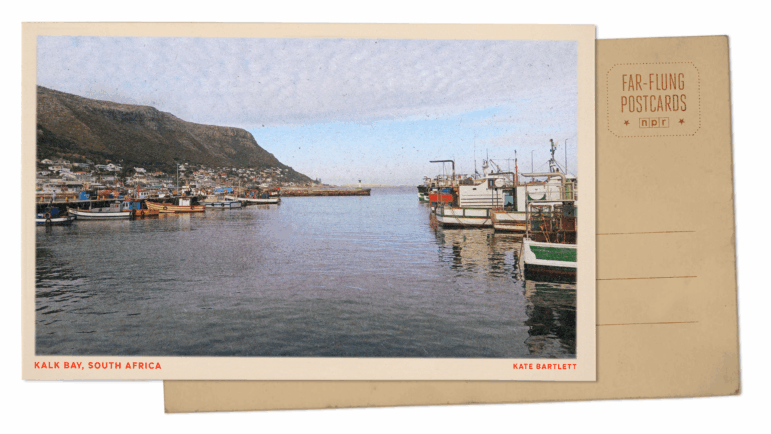
The colorful old wooden fishing boats rock gently in this harbor, where wild — and suspiciously plump — Cape fur seals bask in the sun, awaiting the entrails from the daily catch as fishermen deftly gut the snoek and yellowtail they’ve brought in that morning.
Kalk Bay, a small village on the Indian Ocean with a bohemian vibe, about 40 minutes’ drive from central Cape Town, is one of my favorite places. It’s nestled in the shadow of fynbos-covered mountains and boasts some atmospheric seafood restaurants and bars where, at high tide, the waves smash against the windows as you eat — and occasionally, an unlucky diner gets soaked!
There’s also an independent bookshop, a couple of art galleries and a population of dedicated surfers and aging hippies (including my dad).
Like much of the Cape region, Kalk Bay is a melting pot with a complex history. In the 1700s, Dutch settlers arrived at Kalk Bay, and it was later occupied by British colonists who turned it into a major whaling center.
But it was the arrival in the mid-1800s of emancipated slaves — who the Dutch East India Company brought over as laborers from what are now Malaysia and Indonesia — as well as Filipino seamen who jumped ship, that made Kalk Bay into a fishing industry hub. Some of the fishermen today are their descendants.
Despite how gentrified and touristy today’s Kalk Bay might be, the harbor is still a real working one — where the weather-beaten fishermen smoke, joke and swear as they throw scraps to the corpulent seals.
See more photos from around the world:
- Greetings from Acre, Israel, where an old fortress recalls the time of the Crusades
- Greetings from a Paris park, where a lone sequoia tree is a marvel to behold
- Greetings from Vienna, where an imperial palace hosts a holiday market for all
- Greetings from Chiloé Island, Chile, where the fast-moving tides are part of local lore