


It’s 20 minutes before Alaska Airlines Flight 626 takes off from San Francisco International Airport for Seattle. Colette Vance closes her eyes and calms herself with rosary beads, hoping that her claustrophobia doesn’t trigger a panic attack.
It happened the year prior, when she was flying back to North Carolina for college. She had intense anxiety and felt as if she was about to die.
“If I’m in a car, I can pull over, open my door and get some relief,” she says. “But when I’m in a plane, there’s no out.”
After graduation, she avoided flying and drove home to California. The inconvenience of a cross-country road trip inspired her to confront her fear of flying.


Which is how she wound up on this commercial flight with a group of other anxious passengers. They’re all on board for the final step in a training called the Fear of Flying Clinic, hosted at the San Francisco International Airport.
Fear of flying affects about 25 million Americans, and many psychologists say that the way to get over a fear is to gradually face it. But that’s often hard to do with air travel if you’re on your own, in public, surrounded by strangers. That’s where the Fear of Flying Clinic comes in: over four days, participants are able to get slow exposure to the flying experience, as well as training and support from mental health and aviation professionals.
More information from insiders goes a long way
Fran Grant and Jeanne McElhatton, both licensed pilots, founded the clinic in 1976. They created an educational program to help Grant’s husband overcome his anxiety about turbulence so that he could travel with them.
Today, volunteers put on the workshop — many of whom have gone through the clinic themselves. It’s one of a handful of programs like it in the country.
Participants are afraid of flying for various reasons: recent aircraft accidents and air traffic controller shortages, traumatic experiences that flying reminds them of (like living through an earthquake), or a fear of heights.
The first part of the training is designed to give nervous flyers more information about flight safety. Working pilots, air traffic controllers, flight attendants and aircraft maintenance technicians present to the group and answer their questions — on everything from advancements in aircraft technology to safety protocols for pilots during thunderstorms.


Rewiring the fear response
The second big part of the training uses cognitive behavioral therapy (CBT) to help participants work on changing distorted thinking patterns that equate the presence of adrenaline with the presence of a real threat.
Using what’s known as the “ABC model,” volunteer psychotherapist Paula Zimmerman writes the letter “A” on a large sheet of paper at the front of the room. “A” stands for an “activating event” — the thing that triggers fear — like, for example, turbulence.
Then she adds “B,” for belief — let’s say someone believes that any time they experience turbulence, it means the plane is going to crash.
Finally, she writes “C,” the consequence of that belief, which could be something like a panic attack.
If you believe turbulence means the plane is going to crash, it makes sense you’d be terrified. However, turbulence is a normal part of flying and doesn’t necessarily mean anything is wrong.
Zimmerman spells all this out so that when flyers get scared on a real flight, they can work through this process on their own and try to correct their faulty thinking. With the example of turbulence, she offers a reframing tool: instead of saying “turbulence scares me,” she suggests people tell themselves: “I upset myself when there’s turbulence.”
Face to face with a 787
The other big technique the clinic relies on is slowly exposing participants to the sights and sounds of planes.
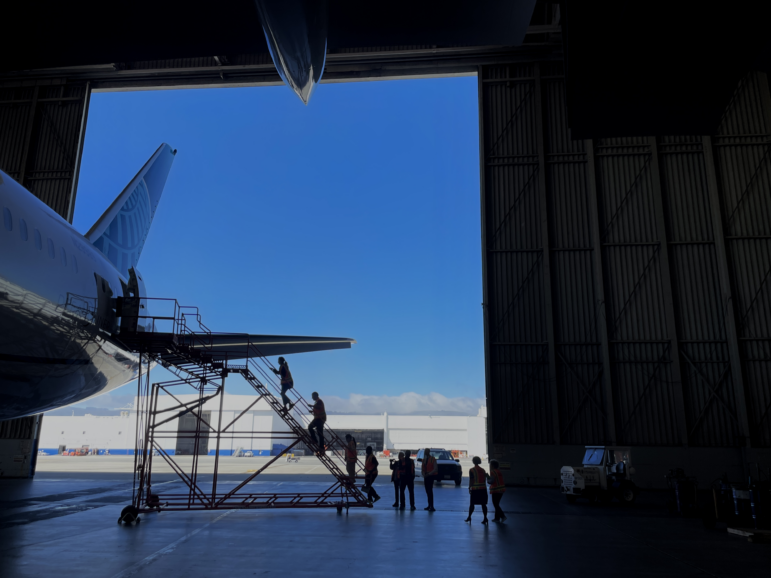
On the second day of the training, participants visit a maintenance hangar and gather beneath the tail of a 787.
Just seeing the outline of the emergency exit door triggers a sense of dread for Vance, who practices Zimmerman’s reframing.
“It’s just an airplane,” she tells herself. “Airplanes don’t harm anybody.”

One by one, participants climb inside. Vance sits in a window seat, which is more likely to trigger her claustrophobia. She starts to feel sick and rests her head on her mother’s shoulder. But after some deep breathing, and processing with her mom and Zimmerman, she feels better. Eventually, she’s well enough to tour the cockpit.
This lower level of exposure is a dress rehearsal for what comes next — the commercial flight to Seattle.
Graduation in the sky
Vance and other participants meet at the airport early on a Sunday. Vance goes through security, boards and sits in a window seat. Three other volunteers from the clinic — including a retired pilot and psychotherapist — are also there to support the anxious flyers.

(Evan Roberts)
The flight starts off a little rocky for Vance, but she focuses on her breathing and rides out the wave of anxiety. She says the support of everyone around her makes it easier.
“ I’m feeling really safe on this flight,” she says, “I’m really hopeful that I’m gonna do way more of this.”
When the wheels hit the runway in Seattle, the clinic group erupts with cheers and congratulations.
On the flight back later that day, Vance opens the fortune cookie she received with her lunch at the airport.
“You will travel to many exotic places in the next few years,” it says.
Transcript:
LEILA FADEL, HOST:
Plane crashes are rare. Even so, tens of millions of Americans are afraid of flying. Some psychologists say the way through is to gradually face the very thing that feels dangerous. Easier said than done. A program hosted at San Francisco International Airport tries to help. Evan Roberts reports.
EVAN ROBERTS: On a flight to Seattle…
(SOUNDBITE OF ARCHIVED RECORDING)
UNIDENTIFIED FLIGHT ATTENDANT: We are preparing for departure. Please make sure to put your seat back and tray tables and tablet holders are all up.
ROBERTS: A woman in the window seat grips a string of rosary beads. Her name is Colette Vance (ph). She’s 23, and she’s a nervous flier.
COLETTE VANCE: It’s OK. It’s all right, girl.
ROBERTS: Vance gives herself a pep talk as the plane accelerates.
VANCE: You’re doing such a good job, Colette. You’re in control.
ROBERTS: Vance is not the only anxious passenger on board. There’s Paul (ph) in the row in front of her and Sarah (ph) seated on the other side of the aisle. This is a regular commercial flight, but these flyers are on the plane with some support staff as part of a training to help people deal with anxiety around air travel.
VANCE: I think for a long time, I felt hopeless. Like, there’s just no point in trying anymore. Like, people aren’t going to be patient with me, and, like, here I am, and people are being so gracious with me.
ROBERTS: The training is called the Fear of Flying Clinic, and it’s one of a handful of programs like it in the country. It was started 50 years ago in the Bay Area by two pilots. Today, it’s a nonprofit with volunteer therapists and aviation experts that run a four-day workshop for clients from across California. The flight to Seattle is the last event in the training, but it starts in a room at the San Francisco International Airport overlooking the gates.
(SOUNDBITE OF ARCHIVED RECORDING)
JODY YARBOROUGH: Hey, everybody. Welcome.
ROBERTS: Participants are greeted by organizer Jody Yarborough.
(SOUNDBITE OF ARCHIVED RECORDING)
YARBOROUGH: So congratulate yourself on taking another step in facing your fears about flying.
ROBERTS: The people participating in the clinic are afraid of flying for all kinds of reasons – recent aircraft accidents and air traffic controller shortages, traumatic experiences that flying reminds them of – fear of heights. Vance is claustrophobic, which being on a plane triggers. She once drove across the country to avoid flying.
VANCE: And after that drive, I ended up realizing I need to confront this. I couldn’t let dreadful anxiety control me anymore.
ROBERTS: The clinic tries to treat those fears with cognitive behavioral therapy, or CBT. That’s talk therapy that usually involves efforts to change distorted thinking patterns. The group is led on the first day by psychotherapist Paula Zimmerman. She writes on a big piece of paper at the front of the room, explaining what she calls the ABC model.
PAULA ZIMMERMAN: A stands for activating event.
ROBERTS: Like turbulence, for example.
ZIMMERMAN: And this B is for belief.
ROBERTS: Let’s say someone believes that anytime they feel turbulence, it means the plane is going to crash.
ZIMMERMAN: C for consequence.
ROBERTS: The consequence to that belief could be a panic attack. Zimmerman is trying to get these anxious fliers to interrogate their beliefs. If they believe that turbulence means the plane is crashing, then of course, they’d be terrified. But, in fact, turbulence is a normal part of flying and doesn’t necessarily mean anything is wrong. So Zimmerman encourages people that when they experience turbulence and feel that fear…
ZIMMERMAN: It’s not the plane. It is not where I am. It is what I’m thinking about where I am. And those thoughts are making that adrenaline skyrocket in me.
ROBERTS: The next day, participants slowly get exposure to a grounded plane so they can experience it in a more controlled environment and practice how to manage their discomfort. And one week later…
(SOUNDBITE OF FASTEN SEAT BELT INDICATOR)
VANCE: So good.
ROBERTS: They’re in the air on the graduation flight to Seattle. The flight starts off a little rocky for Vance, but she focuses on her breathing and rides out the wave of anxiety. She says the support of everyone around her helps. As the plane descends, she realizes she’s made it through.
VANCE: (Laughter) I’m, like, so…
UNIDENTIFIED PERSON #1: Yeah.
VANCE: …Happy. I just…
UNIDENTIFIED PERSON #1: Yeah.
VANCE: ‘Cause it’s like, oh, my gosh, I didn’t cave.
ROBERTS: When the plane lands, all of the clinic participants clap.
(APPLAUSE)
VANCE: On the plane ride back home, Vance opens a fortune cookie from her lunch. It reads, you will travel to many exotic places in the next few years.
UNIDENTIFIED PERSON #1: Good job, you guys.
UNIDENTIFIED PERSON #2: (Laughter).
UNIDENTIFIED PERSON #1: Amazing.
ROBERTS: For NPR News, I’m Evan Roberts in San Francisco.
(SOUNDBITE OF SONG, “FLY LIKE AN EAGLE”)
SEAL: (Singing) Let my spirit carry me. I wanna fly.