


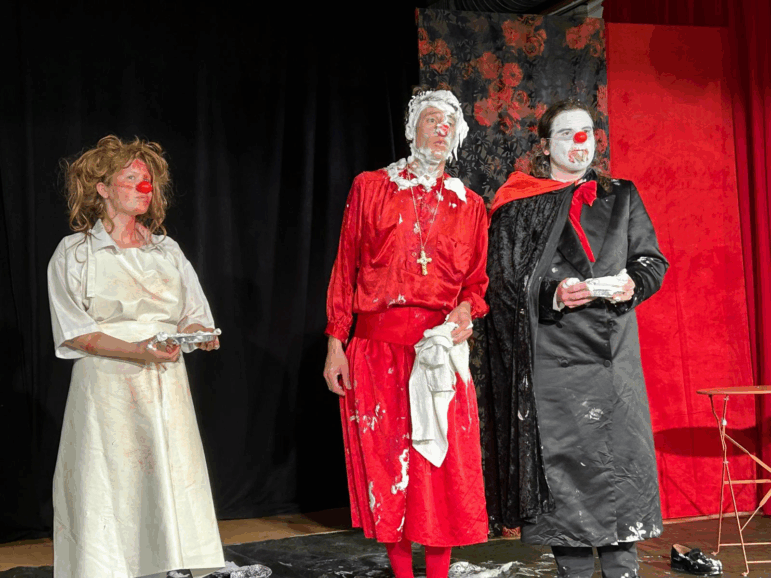
ÉTAMPES, France — The man in control tonight is named Carlo Jacucci. You’re on the stage. He’s the audience. And there’s almost no chance you’re going to please him — which, somehow, is exactly why you’re here.
“The games begin,” Jacucci, a matter-of-fact Franco-Italian, tells his students, then taps a drum between his legs.
The stage lights go bright. The music starts. A group of red-nosed clowns in various costumes begins a ritual that has been the heartbeat of this place for more than 40 years.


This is the École Philippe Gaulier, a school named after its founder, a teacher who believed comedy and clowning begin not with jokes, but with the pleasure of being ridiculous. Or, as Gaulier calls it, finding “your idiot.”
Doctors, priests, actors — they come from all over the world to study this philosophy in the otherwise sleepy village of Étampes, about an hour’s train ride south of Paris. The loudest noises after sundown come from a room full of English speakers learning to fall on their faces.
A stroke in 2023 forced Gaulier, now in his early 80s, to retire from teaching full time. But the school still runs on the system he built — carried on by the teachers he trained — shaping every exercise, every critique and nervous student hoping for a laugh.
Students like Brazilian actress Gabriela Flarys. She’s standing on the stage in an oversize frilly orange-and-white flamenco dress, prompting Jacucci to nickname her “orange broccoli.”
Flarys’ act is not going well. Her stage partners are a man dressed as a Roman warrior and another as a mariachi with an oversize sombrero. The premise involves a love triangle.

“Welcome everyone to the worst moment of the class,” Jacucci says flatly. “We reached it.”
The trio stares back at him. They’re confused. Ashamed.
The worst moment has a name here — le flop. It’s the part everyone dreads, when you can feel your red nose begin to droop as the dead air fills the room. But it’s also where the real work begins.
Jacucci singles out Flarys. She needs more emotion. He tells her to get angry at him. What happens next feels almost like an exorcism.
“Carlo!” she shrieks, shouting Jacucci’s first name. “I’m pissed off!”
She gets louder. And louder. Until something breaks loose. Then she calms down.
“Wait,” she tells the crowd, then picks up a shaving cream pie and throws it at the mariachi’s face.
The room laughs with her. Even Jacucci looks stunned.
“Me, I am shocked,” he says. “I didn’t know you could change.”
Painful but also refreshing


Teaching is Jacucci’s second act.
A longtime performer, he first came to Gaulier as a student decades ago. He says he found the experience painful — but also refreshing.
“[Gaulier] had no problem telling me the truth of what he saw,” he says.
“I felt immediately that this is a work that allows you to progress, because you face your limitations.”
Gaulier’s method has produced an unlikely list of alumni: including actors Rachel Weisz and Emma Thompson, both Oscar winners, and Helena Bonham Carter and Sacha Baron Cohen.
A new generation is also emerging.
A decade ago, Zach Zucker was working for Baron Cohen’s production company in Los Angeles when Gaulier came to town to do a workshop. Zucker signed up.
“And five minutes in, I saw Philippe work his magic, and I just could not believe what I was watching,” Zucker says.
Zucker had trained in American improv schools, including Second City and Upright Citizens Brigade. But this felt different. Other places teach you how to succeed. Gaulier, he says, was teaching people how to fail.
“Everyone’s good at being good,” Zucker says. “But if you can be good at being bad, then nothing is bad — and it’s actually more enjoyable.”
Zucker eventually moved to Étampes, where he studied under Gaulier for two years.
Today he is the ringmaster of Stamptown, a traveling vaudeville show that leans heavily into the Gaulier philosophy. His alter ego, Jack Tucker, repeatedly bombs on stage — and folds the failure into a part of the act.
It’s a schtick that’s catching on — the show will air its first Netflix special later this year.
Julia Masli signed up for the school a decade ago after learning there was no audition process.
“So straight away I signed up and that was basically my only education,” she says.
In her one-woman show, Ha ha ha ha ha ha ha!, Masli invites the audience to share their problems, which she then helps solve in real time. The show became a breakout hit at the Edinburgh Fringe festival.
Despite her success, Masli admits she spent years struggling to get a laugh. Gaulier’s brutal training helped her prepare for that.
She remembers telling him she was from Estonia.
“He kept saying it’s a very gray country, and there’s no one funny there,” she recalls.

Masli quickly learned her teacher would never settle for anything less than brilliant.
The pleasure to be ridiculous
Gaulier was born in Nazi-occupied Paris in 1943. He trained to be a serious actor, but noticed that whenever he appeared on stage, audiences laughed.
Gaulier went on to study and later work with the mime teacher Jacques Lecoq. In 1980, Gaulier founded his own school, which has had stints in Paris, London, and for the past 15 years, in Étampes.
That doesn’t mean everyone is made for this work.
“This pleasure to be ridiculous … to have a special humor … it’s given to some people,” Gaulier told the BBC in 2015. “But not many.”
Michiko Miyazaki Gaulier, his wife and former student, now runs the school’s day-to-day operations, keeping the schedule — and the Gaulier method — on track. She promises everyone leaves with something.
“People come here to change,” she says. “Maybe they don’t know what — but they want to change.”
Back inside Jacucci’s classroom, students are still figuring out what that change looks like.
After class, Frank Benson, the Roman warrior, is still catching his breath.
“It was tough today,” says Benson, who came from Australia to study here. “Sometimes you go out there and it flops really hard, and it’s not so fun.”
But, he says, he’s getting used to it. The disappointment passes faster now.
In another corner of the room, Flarys, aka orange broccoli, is wiping the sweat off her face.
She has a confession: This is actually her third stint at the school. Even with over 15 years of experience performing, there’s something that keeps her coming back here.
What has she learned?
She says, “Nothing is a mistake if you play with it.”
Transcript:
SCOTT SIMON, HOST:
At a famed clown school near Paris, students are taught how to fail. They pay for it. They’re critiqued on it and sometimes humiliated by it. Reporter Rebecca Rosman got a rare peek inside the classroom where flopping is mandatory and what matters is what students do next.
REBECCA ROSMAN, BYLINE: Few things are more terrifying than the idea of stepping onto a stage, staring out at a room full of strangers and hoping desperately that you can make them laugh.
UNIDENTIFIED PRESENTER: Six acts.
(CHEERING)
UNIDENTIFIED PRESENTER: Should we go into the first?
(SOUNDBITE OF MUSIC)
ROSMAN: This is the Ecole Philippe Gaulier, where people have been paying – yes, paying – to risk public embarrassment for more than 40 years. And tonight, I’m the one watching students perform short acts where the punch line is almost always a pie in the face.
UNIDENTIFIED STUDENT #1: And I just do it.
(LAUGHTER)
ROSMAN: Everyone is in costume, red noses and all – a giraffe, a mermaid, a man in a sombrero. Their assignment? Be funny. They usually aren’t.
UNIDENTIFIED STUDENT #2: Don’t hurt me. I’m just a little boy.
UNIDENTIFIED STUDENT #3: Give me one of those pies.
ROSMAN: People come from all over the world to study here – doctors, priests, actors. They gather in the small town of Etampes, about an hour south of Paris, where they regularly endure feedback like this.
(SOUNDBITE OF ARCHIVED RECORDING)
PHILIPPE GAULIER: We were not laughing. We were embarrassed. We are not sure if you are happy to see us.
ROSMAN: That’s Philippe Gaulier, the school’s founder, speaking to students during a workshop the BBC recorded back in 2015. For Gaulier, clowning isn’t about technique. It’s about play. But he says not everyone is built for this work.
(SOUNDBITE OF ARCHIVED RECORDING)
GAULIER: This pleasure to be ridiculous, this pleasure to have a special humor – no, no. It’s given to some people, but not everybody.
ROSMAN: A stroke three years ago forced Gaulier to retire from full-time teaching. But his fingerprints are everywhere here, shaping every exercise, every critique and every nervous student hoping for a laugh. Just like his predecessor, instructor Carlo Jacucci doesn’t mince words.
CARLO JACUCCI: I see two clowns looking aimlessly in this direction and wasting our time.
ROSMAN: Jacucci, a matter-of-fact Franco Italian who has been teaching here for more than a decade, sits with a drum between his legs. And when it sounds…
(SOUNDBITE OF DRUM)
JACUCCI: Thank you.
ROSMAN: …It’s time.
JACUCCI: Welcome, everyone. The worst moment of the class – now we have reached it. It will not be worse than this.
ROSMAN: The worst moment. They call it le flop -the part everyone dreads. But it’s actually where the real work begins. Student Gabriela Flarys is from Brazil.
GABRIELA FLARYS: OK. Should I be angry? With who?
(LAUGHTER)
JACUCCI: With me.
ROSMAN: She’s standing on the stage in an orange flamenco dress, looking confused. Something about her act just isn’t landing and needs more emotion. Jacucci tells her to get angry.
FLARYS: Carlo.
JACUCCI: Yes.
FLARYS: I’m pissed off.
JACUCCI: Oh, I feel so afraid.
(LAUGHTER)
ROSMAN: She gets louder and louder until something breaks loose.
FLARYS: Carlo. Carlo. Aah.
ROSMAN: And then she throws a pie at her stage partner.
FLARYS: I’m fed up of – oh, one sec. One. Just…
(SOUNDBITE OF PIE HITTING FACE)
UNIDENTIFIED PERSON #1: Woah.
UNIDENTIFIED PERSON #2: Woah.
(APPLAUSE)
ROSMAN: The room laughs with her. Even Jacucci looks stunned.
JACUCCI: Me – I am shocked. I didn’t know you could change.
ROSMAN: Cathartic moments like this have fueled a new generation of performers who are redefining what it means to clown.
(SOUNDBITE OF ARCHIVED RECORDING)
ZACH ZUCKER: I just want to get to know this crowd. This is truly one of the most beautiful crowds I’ve ever seen in my entire life.
ROSMAN: Among them? Zach Zucker.
(SOUNDBITE OF ARCHIVED RECORDING)
ZUCKER: If I may?
(LAUGHTER)
ZUCKER: May I approach?
ROSMAN: His alter ego, Jack Tucker, leads “Stamptown,” a high-energy, raunchy vaudeville variety show with a global following. A decade ago, Zucker was working for Gaulier alum Sacha Baron Cohen in Los Angeles when he heard Philippe was in town, teaching a workshop.
ZUCKER: And five minutes in, I saw Philippe work his magic, and I just could not believe what I was watching.
ROSMAN: Zucker had trained in American improv schools, Second City and Upright Citizens Brigade among them. But this felt different. Other places teach you how to succeed. Gaulier teaches you how to fail.
ZUCKER: Everyone’s good at being good. And if you can be good at being bad, then nothing is bad, and it’s enjoyable. And it’s actually more humbling.
ROSMAN: Zucker’s “Stamptown” leans into that.
(SOUNDBITE OF ARCHIVED RECORDING)
ZUCKER: Sorry. I didn’t realize this crowd was laughtose-intolerant.
ROSMAN: And now it’s getting noticed. The show will run a special on a major streaming platform this year.
(APPLAUSE)
ROSMAN: But back in Etampes, success feels far away. Clowning here is still raw, still painful. After class, I find student Frank Benson from Melbourne still catching his breath.
FRANK BENSON: Oh, it was tough today.
ROSMAN: It was tough?
BENSON: It wasn’t a good day for me. Yeah. It was – I felt like – sometimes you go out and it flops really hard, and it’s not so fun.
ROSMAN: But he says he’s getting used to it. The disappointment passes faster now. And for some, it opens the door to something new. Here’s Gabriela Flarys again.
FLARYS: Nothing is a mistake if you play with it, if you’re being honest with the present moments, I think. This is the poetry of this school. Everything is open, and it’s poetry and possibilities. Nothing is defined.
ROSMAN: Nothing is a mistake if you play with it. That might be Philippe Gaulier’s legacy – learning how to stand in front of a room, bomb completely and keep going, even if there’s nothing to show for it in the end but a pie in the face.
Rebecca Rosman, NPR News, Etampes, France.
SIMON: Oof. But no clowning around.
BJ Leiderman does our theme music.
(SOUNDBITE OF DELICATE STEVE’S “NEARLY EVERYTHING”)