


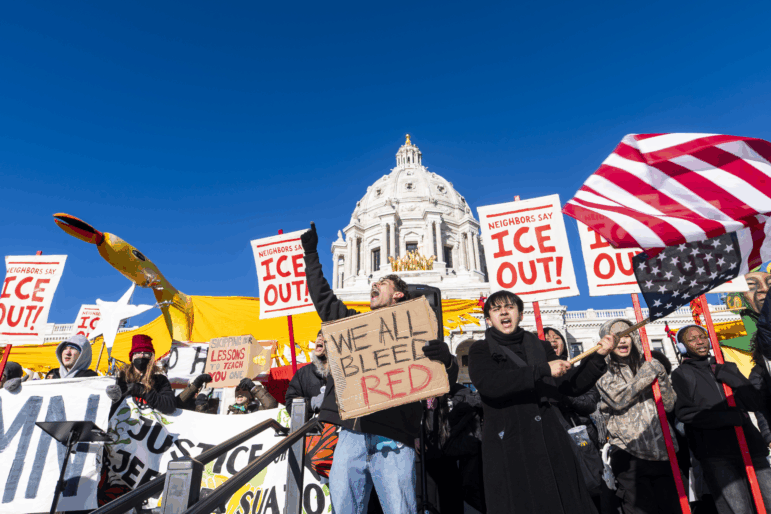
The deaths of Renee Macklin Good and Alex Pretti have shaken up the conversation about how states should respond to immigration crackdowns across the country.
Some Democratic leaders have vowed to hold federal Immigration and Customs Enforcement officers accountable — even charging them with crimes.
After an ICE surge in Chicago last year, state leaders established the Illinois Accountability Commission to collect evidence from citizens about ICE’s actions, including the agency’s leadership, and to make accountability recommendations.
The chair of the commission and former federal judge, Rubén Castillo, says the group is having conversations with local law enforcement to “suggest prosecutions that should be coming as we speak.”
Prosecutors in Philadelphia and California say they are also considering criminal charges against federal agents.
Can states charge federal agents with crimes?
White House officials have raised the idea of agents having immunity when they’re on the job, but legal experts say that is not the case.
“There is no structural or blanket barrier to states bringing a criminal prosecution against federal officials,” says Harrison Stark, an attorney who works with the University of Wisconsin Law School’s State Democracy Research Initiative.
“If a state believes that a federal official has violated state criminal law,” Stark says, “the state has broad Investigatory Powers to collect evidence, to explore that criminal action, basically in the same way they would against anybody else.”
And it’s not just about criminal prosecutions; Illinois has a law on the books that allows people to sue federal agents in civil court. The Trump administration has sued to block the law, saying it violates federal powers. Democratic lawmakers in New York, California, Colorado and Oregon are considering similar laws.
Republican-led states lean into enforcement
After Trump took office last year, many red states jumped to support the president’s mass deportation efforts.
In Tennessee, the state provides grants to law enforcement agencies that work with ICE. Since that was passed last year, the number of sheriff’s offices and police departments that have signed a formal agreement with ICE has skyrocketed.
Now, Republican lawmakers in the state are considering making that voluntary program involuntary as part of a bigger immigration package. Kentucky lawmakers are moving in the same direction.
This year, Tennessee is piloting legislation made in partnership with Steven Miller, Trump’s deputy chief of staff for policy, and the White House.
One of the policies would make it impossible for someone without legal status to buy a car, earn a nursing certificate or receive any government benefits. (Many government benefits are already off-limits to people living in the country illegally.) “We’re not spending taxpayer dollars on you unless you’re in jail,” is how Cameron Sexton, the Republican Tennessee House Speaker, explained it when announcing the legislation.
The Indiana Senate last week passed a measure that would tighten requirements for local agencies, including universities, to cooperate with immigration enforcement. Last month, New Hampshire took a page out of Tennessee’s book by banning sanctuary cities. Meaning, cities can’t impede federal immigration officers from carrying out their duties.
Blue states limiting ICE cooperation
Some Democratic-led states are considering mask bans or ID requirements for federal agents. California’s law on that is currently tied up in court.
Illinois has a law limiting police cooperation with ICE that lawmakers say they want to expand this year. Last week, New York Gov. Kathy Hochul announced legislation to do that, too.
Maine has set up a tipline to report ICE activity and abuses.
Democrats in other states, including Massachusetts, are looking at creating “safe zones” around courthouses, schools, churches and hospitals where agents are not allowed to make arrests.
In a couple of weeks, the Minnesota legislature will meet for the first time since the ICE surge there. Democrats say they’re ready to pass a bill that would enable Minnesotans to sue federal agents, and changes to help renters affected by immigration enforcement avoid eviction.
While Democrats control the Minnesota Senate, the state House is split between the two parties, meaning Democrats will need some Republican support to pass any new proposals.
Transcript:
JUANA SUMMERS, HOST:
Can local officials, even local residents, take action against federal immigration agents? After federal agents killed two U.S. citizens in Minnesota and amid scenes of their tactics with protesters and immigrants, officials in some Democratic-led states say they can charge federal agents with crimes. On the other hand, Republican state lawmakers say they’ll do more to assist those agents. To talk about this, we’re joined by Marianna Bacallao with member station WPLN in Nashville and Mawa Iqbal in Springfield, Illinois, with WBEZ. Hi to both of you.
MAWA IQBAL, BYLINE: Hello.
MARIANNA BACALLAO, BYLINE: Hi.
SUMMERS: Mawa, let’s start with you and what has been happening in Illinois since the ICE surge there last fall. Tell us the latest.
IQBAL: Right. So the surge last fall saw crowds of protesters often clashing violently with ICE agents, and then agents, you know, slamming people to the ground, putting them in choke holds. So Governor JB Pritzker, who’s the Democrat here, has started what’s called an Accountability Commission to essentially collect evidence from citizens about ICE’s behavior, both towards protesters and immigrants. It actually just met on Friday. So here’s what the chair of the commission, who’s a former judge, Ruben Castillo, had to say about potentially prosecuting ICE agents.
(SOUNDBITE OF ARCHIVED RECORDING)
RUBEN CASTILLO: We will have conversations with those in local law enforcement to suggest prosecutions that should be occurring even as we speak.
IQBAL: The commission will now make recommendations about how to hold federal agents accountable. I even talked with one prosecutor from the Chicago suburbs who’s looking at a couple of complaints from bystanders who say they were pepper-sprayed. This is something that prosecutors in Philadelphia and California have also talked about doing – you know, holding agents accountable.
SUMMERS: Right. And I know that you’ve been looking into the law on this. Can they prosecute?
IQBAL: Well, White House officials have raised this idea that agents have blanket immunity when they’re doing their job, but they’ve also kind of went back and forth on that statement. But legal experts say that this is just not the case. This is what Harrison Stark, who is an attorney who works at the University of Wisconsin Law School’s State Democracy Research Initiative, told me recently.
HARRISON STARK: There is no structural or blanket barrier to states bringing a criminal prosecution against federal officials or for state laws applying to federal officials while they’re performing federal function.
IQBAL: So he says it’s really a case-by-case basis. You know, were these agents performing within the scope of their duties, or did they cross a constitutional line? And it’s not just about criminal prosecutions. Illinois also has a law on the books that gives people the power to sue federal agents. The Trump administration has recently sued to block that, saying it violates federal powers, but lawmakers in New York, California, Colorado and Oregon are, as we speak, considering proposing similar legislation.
SUMMERS: Marianna, Tennessee is going in just a totally different direction, at least at the state level. What are lawmakers there talking about?
BACALLAO: Right. Some lawmakers here are leaning into Trump’s immigration agenda. They provide grants to local law enforcement agencies that work with ICE. Under that, the number of sheriffs’ offices and police departments that have signed a formal agreement with ICE have skyrocketed. Now, they’re considering making that voluntary program involuntary. This year, Tennessee is piloting legislation made in partnership with the White House. Tennessee House Speaker Cameron Sexton announced the legislation. One of the policies would make it impossible for someone without legal status to buy a car, earn a nursing certificate or receive any government benefits. Here’s House Speaker Sexton.
(SOUNDBITE OF ARCHIVED RECORDING)
CAMERON SEXTON: And we’re not spending taxpayer dollars on you unless you’re in jail.
BACALLAO: Trump has touted Tennessee as one example of states cooperating on immigration enforcement.
SUMMERS: And what are other Republican-led states doing?
BACALLAO: Well, after Trump got elected, a lot of states passed laws last year to support his mass deportations. Now we’re seeing new proposals. A lot center on tightening up requirements for local agencies to work with federal immigration agents. The Indiana Senate passed a bill like that last week. And when a Democrat criticized what ICE is doing in Minnesota, Republican state Senator Mike Gaskell echoed the defense the White House has made. Gaskell says that bill is a way to keep that, quote, “chaos” from happening in the Hoosier state.
(SOUNDBITE OF ARCHIVED RECORDING)
MIKE GASKILL: Think of how much easier things would be in Minnesota if political leaders of that state were not inciting an army of citizens who think it’s OK to attack law enforcement.
BACALLAO: Of course, Minnesota Democrats say they’re not inciting violence but that people have a right to peacefully protest. Next door from here, in Kentucky, lawmakers might require all law enforcement agencies to enter agreements with ICE, like Tennessee’s proposal. And last month, a New Hampshire law took effect banning sanctuary cities, like Tennessee has done.
IQBAL: Yeah. Leaders in blue states are going in a completely different direction. Illinois, for example, we have a law on the books essentially limiting police cooperation with ICE that lawmakers are now saying they want to expand upon during this spring legislative session. Maine has also set up a tip line to report ICE activity and abuses. And some states are also looking at mask bans or ID requirements for federal agents, which California already has but is currently tied up in the courts there. Other states, like Massachusetts, are also looking at creating what they call safe zones around courthouses, schools, churches and hospitals where agents are not allowed to arrest people.
SUMMERS: And Marianna, we should note that even though you’re in a Republican-led state, there is also dissent, especially in places like Nashville where you are.
BACALLAO: Yeah. Nashville, as a city, is not usually in agreement with state leaders. I’ll take the past week as an example. Republicans were rolling out the legislative package on that pilot program with the White House. It happened to be when we were having a historic winter ice storm. Immigration advocates say some people were afraid to call for help as their power went out because they worried they’d get on the radar of immigration enforcement. Protesters in Nashville still showed up in the cold outside the city’s Homeland Security office to demonstrate against ICE. One protester, Ingrid McIntyre, says there’s growing opposition to what lawmakers are doing here.
INGRID MCINTYRE: As these crowds grow, I think that that gives me hope.
BACALLAO: But in our system, states have a lot of power to decide what cities do.
SUMMERS: That’s Marianna Bacallao in Nashville and Mawa Iqbal in Springfield, Illinois. Thanks to both of you.
IQBAL: Thank you.
BACALLAO: Thank you.