


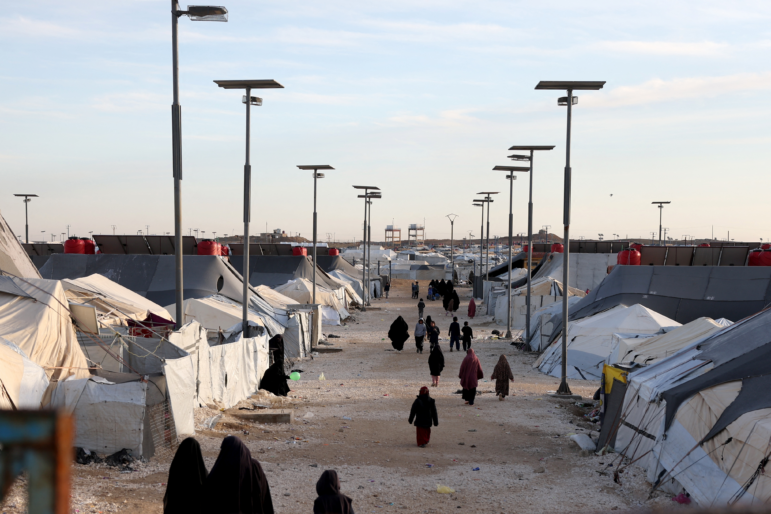
AMMAN, Jordan — Rising up out of the desert in a territory recognized by almost no one, the huge al-Hol camp in northeastern Syria for years had posed an intractable problem — a destitute and increasingly dangerous detention site where ISIS ideology lived on.
Syrian Kurdish forces guarded and administered the camp and detained tens of thousands of women and children there. The detainees had been part of the Islamic State’s self-declared caliphate, which the militant group built after seizing large parts of Syria and Iraq in 2014, and which was defeated by U.S. and Kurdish forces in 2019.
On Tuesday, the Kurdish-led Syrian Democratic Forces (SDF) said in a statement that “due to the international community’s indifference towards the ISIS issue and its failure to assume its responsibilities in addressing this serious matter, our forces were compelled to withdraw from al-Hol camp and redeploy.”


The SDF said the camp’s guards were deployed to cities in northern Syria to confront the threat from Syrian government troops taking over Kurdish-held territory. Syrian government forces have moved in to secure the camp, saying the security vacuum had allowed some detainees there to escape.
U.S. Central Command said Wednesday it was starting to transport thousands of detained ISIS fighters to an unnamed “secure location” in neighboring Iraq, but the fate of the tens of thousands of ISIS family members at al-Hol remained unclear.
ISIS’ last stand was in Syria
Pushed out of Iraq by U.S.-backed Iraqi forces, ISIS made its last stand in Baghuz, Syria, about 200 miles south of al-Hol. While the United States provided intelligence, coordination and air cover, the forces on the ground in Syria were mostly Kurdish-led fighters who had controlled the northeast of the country since breaking away from authoritarian President Bashar al-Assad’s rule in 2012 during a bloody civil war. The Syrian Kurds say they lost more than 25,000 fighters battling ISIS with the United States.
Syria’s civil war only ended when Assad fled the country in late 2024, toppled by fighters loyal to Syria’s new president, Ahmed al-Sharaa. The new leader was once associated with al-Qaida but now insists he wants an inclusive, democratic Syria.
After ISIS was defeated, the group’s surviving fighters were placed in more than a dozen prisons. Their wives and children — many of them sick and starving — were detained in al-Hol.
While U.S. military commanders have long linked lack of security in the camp to a resurgent ISIS, the U.S. has become increasingly disengaged, according to former officials and researchers.
“Taking over a camp this large would normally require a detailed and deliberate handover,” says Myles Caggins III, a former spokesperson for the U.S.-led anti-ISIS military coalition in Iraq and Syria and a nonresident fellow at the New Lines Institute.
Kurdish commanders said in a statement they had tried to discuss a handover plan for the camp with U.S. military officials.
The U.S. military did not respond to NPR’s request for comment. It referred NPR to comments made by U.S. special envoy for Syria, Tom Barrack. He said this week on social media “the original purpose of the SDF as the primary anti-ISIS force on the ground has largely expired, as Damascus is now both willing and positioned to take over security responsibilities, including control of ISIS detention facilities and camps.”
Caggins noted that in December, President Trump signed a defense spending bill allocating about $200 million in funding for SDF operations with the U.S.
“But now all of that has quickly changed. The U.S. and Washington, D.C., is running its full counterterrorism relationship through Damascus,” he said.
Losing hard-won territory
Over the past few days, the Kurds have seen their hard-won territory in Syria crumble.
The territory seized by the Kurds and allied Arab tribes in 2012 became the Democratic Autonomous Administration of North and East Syria — known in Kurdish as Rojava, which means “west” — a reference to a dreamed-of greater Kurdistan.
Across the Syrian border, Iraqi Kurds, with the help of U.S. air protection, in 1991 broke away from Saddam Hussein’s regime. Iraqi Kurdish leaders courted Western oil companies and turned the territory into what was known as the most prosperous and stable part of Iraq.
But in Syria’s Kurdish region two decades later, no country recognized its self-declared autonomy and countries and organizations that dealt with the Syrian government were wary of being involved in the breakaway region. Major aid organizations did not publicize their presence there.
The Syrian Kurdish region’s main crossing point to the outside world is, in some seasons, a small floating bridge across a narrow river that connects it to Iraqi Kurdistan.
After holding out for concessions from Syria’s federal government that could allow them to retain some autonomy, they instead faced a military onslaught.
Remnants of the ISIS caliphate largely ignored
At its height in 2019, the al-Hol camp had a population of more than 70,000 residents, and an acute humanitarian crisis.
On a visit to al-Hol with producer Sangar Khaleel in 2019, the camp was particularly desolate. Women in black cloaks with their faces and hands covered in line with their religious faith waited in the rain for limited amounts of food to be dispersed.
“We pray for the Caliphate to return,” one of the women, refusing to give her name due to her religious beliefs, told us.
“Convert, convert!” a group of women and girls chanted around me in Arabic, urging me to recite the shahada, the Muslim profession of faith. The women and girls quoted the Quran — incorrectly — in justifying ISIS killings of those deemed nonbelievers.
“If they don’t convert to Islam and they don’t become Muslim like us and worship God, then they deserve it,” said an Iraqi woman who also refused to give her name. Although they referenced the Quran, many of the women and girls were unable to read.
On another visit, Kurdish armed guards accompanied us to what is known as the Annex — a heavily secured area of al-Hol camp holding women and children who are neither Syrian nor Iraqi.
We were allowed only into the areas deemed safe enough to visit and only for a few minutes. A long row of tents was dubbed “Australia Street” for the young Australian women who followed ISIS fighters to Syria or were unknowingly lured there. Most countries, citing security and logistics concerns, have either refused to repatriate their citizens from al-Hol or have taken years to do so.
Fueled by neglect and hardship, ISIS ideology persists
For years, the region’s Kurdish Syrian leadership and the U.S. viewed the large numbers of radicalized women and children as a continued danger. Although there have been some de-radicalization programs funded by foreign governments, they are not enough and don’t include children, according to Kurdish officials.
Camp officials told The New Humanitarian news site in November that al-Hol’s population was currently about 26,000 people — including about 6,000 foreigners from around 60 countries, excluding Iraq.
None of the residents have been charged with a crime, making their detention in contravention of international law, according to the U.N.
The camp is full of small children — born either during the self-declared caliphate or even in detention afterward as detained boys and girls reach puberty and marry.
Swedish researcher Malene Rembe was at al-Hol last September in the latest of several visits but was unable to enter the foreigners’ section as some residents had just set fire to a project there run by a U.S.-based aid organization.
Rembe, who is writing a book on survivors from the Yazidi religious minority of the ISIS genocide against them, said relations between the more militant residents and the Kurdish guards had deteriorated to the point where the camp guards entered the foreigners’ section only in armored vehicles.
She said the sweeping cuts in U.S. foreign aid last year had also affected the camp and further enraged residents when she was there in September.
“The guards and the staff in al-Hol didn’t know anything in advance so they came to the camp in the morning and were told they had nothing to deliver. So they had no food, no water, nothing,” she said.
She said the U.S. granted an exemption for al-Hol and aid arrived a few days later.
After years of indoctrination, hardship and neglect, many residents of al-Hol still pray for the return of the caliphate, and now face an even more uncertain future than ever.
Transcript:
AILSA CHANG, HOST:
In Syria, fighting between Kurdish-led forces, long back by the U.S. and Syrian government troops, sparked a security collapse at al-Hol. That’s the biggest detention facility for families of Islamic state fighters. The facility holds tens of thousands of people, and some detainees have now escaped. NPR’s Jane Arraf has covered the facility and northeastern Syria extensively. She joins us now from Amman, Jordan. Hi, Jane.
JANE ARRAF, BYLINE: Hi there.
CHANG: So this feels like a pretty dramatic development since just a couple of days ago – right? – when the Syrian president announced a ceasefire. Can you first just tell us a little bit about this massive ISIS detention camp?
ARRAF: Yeah. It’s really hard to explain exactly how desperate, desolate and improbable this al-Hol camp in northeastern Syria is. First, it’s in a breakaway part of Syria that had been unrecognized by most governments and very rarely visited. And the residents included thousands of foreigners, many of them young women who ran away or were lured away by ISIS fighters or left to join the self-declared caliphate, whose governments won’t take them back. And in the past seven years, there’s been a new generation born, including some of the most fervent believers in ISIS now at this camp. There isn’t enough food. There isn’t enough medicine, and it has become increasingly dangerous. It exists because after the U.S. and the Kurds defeated ISIS in Syria in 2019, the Kurds were left in charge of all of these ISIS families and suspected fighters.
CHANG: Wait. So has fighting resumed between the Kurds and Syrian government at this point?
ARRAF: Well, a short while ago, there was another ceasefire. This time, a four-day ceasefire announced, and that’s to give the Kurdish-led forces, the Syrian Democratic forces, or the SDF, time to hand over control of other facilities. But we have to remember it isn’t just about prisons. The Kurds are being told to give up territory, where they created this unique, autonomous region after breaking away from the al-Assad regime during Syria’s civil war.
Now, the Kurds have been a key partner in fighting ISIS. In 2014, when ISIS declared that caliphate, Syrian Kurds say they lost in the fighting after that – 25,000 fighters pushing ISIS back. So what we’re seeing now is a remarkable downfall for the Kurds, defeated by Syrian government that’s headed by former al-Qaida fighter Ahmed al-Sharaa, who renounced that ideology and helped topple the former regime in 2024. He’s backed by Turkey and, increasingly, the U.S.
CHANG: Well, let’s talk about the U.S. because I understand the U.S. has about 2,000 troops in that part of Syria. What has been the U.S. role in all of this?
ARRAF: Well, U.S. military leaders over the years have worried about the ISIS resurgence, and that’s pretty much why they have troops there. But President Trump’s envoy to Turkey, Tom Barrack, put it very succinctly today. He said the U.S. relationship with Syrian Kurds was based on their shared fight against ISIS. And now he said the U.S. didn’t really need them for that. I talked to the former spokesperson for the U.S.-led anti-ISIS coalition in Iraq and Syria, Myles Caggins III. Here’s what he had to say about what had been a close relationship for years with the SDF.
MYLES CAGGINS III: Now, today, by Tweet, U.S. Ambassador Tom Barrack has severed that relationship, emphasizing that it was temporary and transactional.
ARRAF: And Caggin’s also pointed out that the latest U.S. defense bill passed in December included about $200 million in spending on Syrian Kurdish forces in the fight against ISIS. So we’ve got the Kurds feeling both betrayed and very afraid.
CHANG: That is NPR’s Jane Arraf in Amman, Jordan. Thank you, Jane.
ARRAF: Thank you.
(SOUNDBITE OF POST MALONE SONG, “CHEMICAL”)