


By Olivia McMurrey
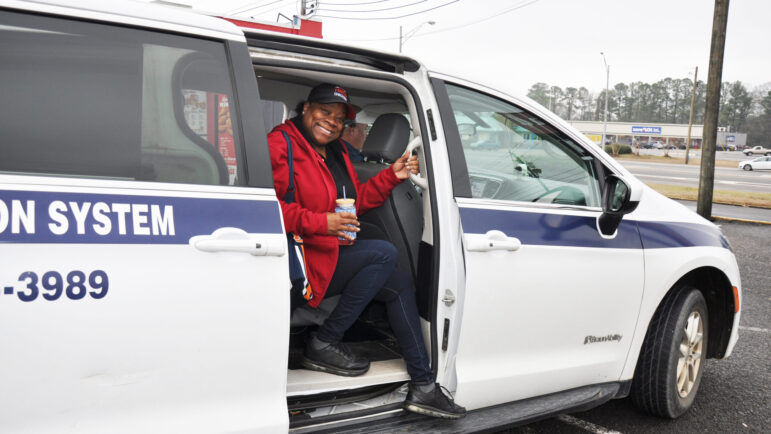
Tracy Murray came out of her house in Jasper, Alabama, wearing the black and red branding of her employer and a matching company cap. Murray is a crew leader at KFC, and her ride to work had just pulled into her driveway on a recent morning. She took a seat in the public-transportation minivan, greeted the driver and paid her $2 fare.
Murray said she’s been using Walker County’s rural transportation program on and off for five years because of bad luck with personal vehicles.
“It seems as though, when I get them, they’re lemons, and don’t last too long,” she said. “But this – the transportation – has been like a godsend, because you get to your doctor’s appointments or the grocery store or to work, just wherever you need to go in Walker County. It provides that for you, and it’s affordable for you.”
The Walker County Transportation System is one of 29 rural public transportation programs that cover 55 of Alabama’s 67 counties. But Murray doesn’t have much company in using those programs to get to work. While lack of transportation is a major employment barrier in Alabama and the state’s workforce participation rate is among the lowest in the nation, less than 1% of residents take public transit to their jobs, according to the U.S. Census Bureau’s 2024 American Community Survey.
Additionally, transportation needs and obstacles are amplified in Alabama’s rural counties, where having a job is more likely to depend on owning a car, yet the percentage of households without a vehicle is higher, per 2024 Census Bureau data. Overall, 7% of households in non-metropolitan counties didn’t have access to a vehicle compared to 5.3% of households in metropolitan counties.
Why people don’t ride to work
The reasons why few Alabamians take public transit to their jobs are varied and complex. Alabama is one of only three states – along with Nevada and Hawaii – that don’t fund public transportation. This means transit programs must rely on federal and local dollars, which advocacy groups say aren’t enough.
“Full solutions to the state’s transit issues will require direct funding investment into capital improvements and operations,” said Dev Wakeley, worker policy advocate for Alabama Arise, a nonprofit that advocates those marginalized by poverty in Alabama. “Investing in public transportation is a proven way to build the infrastructure that frees Alabama workers to provide for their families and their futures.”
The state Legislature created the Alabama Public Transportation Trust Fund in 2018 but has not funded it. For three years in a row starting in 2023, Sen. Linda Coleman-Madison, D-Birmingham, introduced bills that would have directed revenue into the fund. The bills didn’t make it to a vote.
Rural transportation programs in Alabama are primarily funded through the Federal Transit Administration’s Formula Grants for Rural Areas Program and through local matching funds.
Due to funding constraints and the challenges of covering large geographic areas, many rural public transit programs operate limited hours and routes and rarely, if ever, transport people to work. Schedules of 8 a.m. to 3 p.m., with no weekend hours, are common. People who need public transportation in Alabama’s rural areas often work jobs with hours that fall outside the 8-to-5 norm.
Shari Spencer, executive director of ClasTran, which provides transportation services to people who live in rural parts of Jefferson and Shelby counties, said most workplaces the program transports residents to are restaurants and retail establishments.
While the agency helps people access life-sustaining medical care and other necessities, only 900 of its 17,521 rural trips were to or from work in fiscal year 2025, she said.
“Rural areas have spread-out populations, meaning people often live far apart and travel long distances to work, which increases operating costs and vehicle time per passenger,” Spencer said. “Also, because of the distance and traffic, it is often hard to get them to work on time.”
ClasTran operates from 8 a.m. to 5 p.m., weekdays only, and Spencer said lack of funding is the reason it can’t extend hours to better accommodate work schedules.
“Extending our hours would require more drivers, longer hours for dispatchers and the cost for fuel would be higher,” she said. “Despite limited funding and the unique challenges of operating in a state without public transit support, we remain focused on our mission.”
Identifying needs in Walker County
Walker County’s program is unusual in operating 12 hours per weekday – from 6 a.m. to 6 p.m. – and half a day on Saturdays.
Randall Drummond, the driver who took Murray to work, said operations start earlier and end later sometimes, to drop off people at work and medical appointments at 6 a.m. or take them back home if a shift ends around 6 p.m.

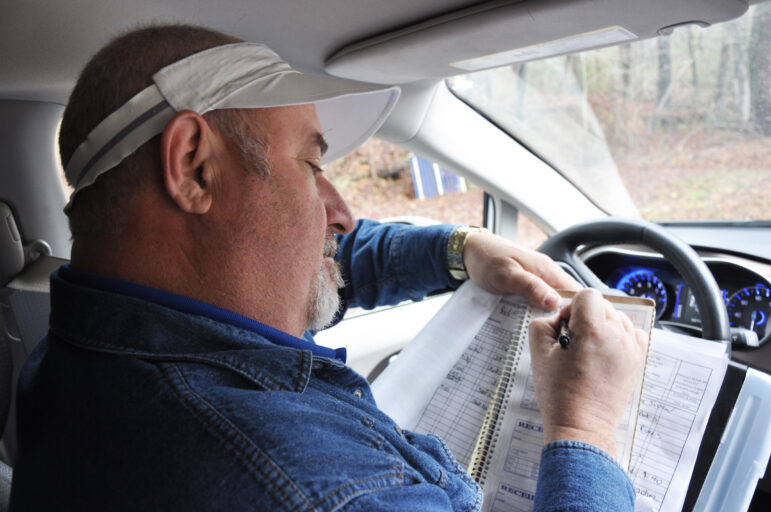
“You have to meet your needs for the community and workers,” he said. “So it’s a little bit flexible.”
After delivering Murray to KFC, Drummond left Jasper – Walker County’s largest city – and headed to pick up a resident in Carbon Hill, a town of 1,500 founded as a coal-mining community in the late 1800s. As he steered the van along a highway that cuts through sparsely forested land, he said the mines provided a lot of good-paying jobs up until the 1980s. Now the median household income in Carbon Hill is $24,000 a year.
“What you see here, undoubtedly, you see a lot in Walker County,” Drummond said. “You just see people struggle to survive, poverty, low-paying incomes, not working.”
The health-care industry has become a leading employer in the area. The county boasts several nursing homes as well as a chain of medical centers that serve low-income residents.
Earnest White, the passenger Drummond picked up in Carbon Hill, works at one of the nursing homes, serving food to residents. White said he would have trouble keeping a job if public transportation weren’t available. Even friends charge him more for a ride, he said.
“Having to ask someone to take me back and forth – they flat out just want $20,” he said. “That’s very much draining. But with this service, it’s just like $6.”

Deidre Tatum, executive director of the Walker County Community Action Agency, which took over operating the transportation program in 2021, said many residents still don’t know about it despite the void it fills.
“Since 2008, we’ve done a needs assessment every three years,” Tatum said. “And transportation was always in the top five needs for this community action agency.”
In particular, lack of transportation was preventing people from working, she said. The agency’s career center helped a lot of people find a job.
“But transportation was usually the biggest obstacle for them getting back and forth to work,” Tatum said.
Across Alabama, 31% of job seekers cited lack of transportation as the primary reason they were unemployed or underemployed, according to a study commissioned by the governor’s office in 2023.
Tatum said the Walker County Community Action Agency was planning to buy a van to transport people to and from work when the Walker Area Community Foundation approached the agency about running the county’s entire public-transit system.
Tatum and her small staff revamped the program, changing it from route-based to on-demand and extending hours. The number of trips increased dramatically.
“The first year, we were probably averaging about 200 or less one-way rides per month,” Tatum said. “Now we’re at about 1,000 per month one-way rides.”
Another reason why Walker County’s program is relatively robust and low cost is because it partners with other local service organizations, Tatum said. She also applies for a lot of grants.
Still, a small number of the program’s riders use the service for work. This is something Tatum hopes to change. She’s currently looking into a grant that would help parents by stopping at child-care centers on the way to or from workplaces. Another idea she has for increasing worker participation is partnering with employers.
Success in south Alabama
A transportation program in south Alabama will implement a similar idea soon.
“If we identify a group of employees that are traveling from the same general area to a specific employer, then we can form a van pool for them and provide them with a new vehicle,” said
Ann Simpson, director of the Baldwin Regional Area Transit System, known as BRATS.
BRATS is already having success transporting people from rural areas to work. Many commute to beachfront communities whose tourism-based economies require hospitality workers who can’t afford to live in those places.
Of BRATS’ 400 daily trips, half involve taking people to and from workplaces. Simpson said that percentage exploded after BRATS adopted an Uber-style app and routing software in late 2020, then upgraded it in June 2025. The software constantly runs algorithms that optimize drivers’ schedules.
“These ride-share companies came on the scene 10, 15 years ago, and then people started looking at, if that works in a private setting, then that should work in a public-transit setting,” Simpson said. “And it does work very well, and it’s a much more efficient way to operate.”
Spencer said an intelligent scheduling platform ClasTran adopted in 2020 has transformed how that organization routes and manages trips for its shared-ride service. She said the software makes routing more efficient and gives ClasTran the ability to serve more clients.
Simpson said she encourages managers of other rural transit programs to consider such technology. Software prices have decreased in recent years, she said, and the Federal Transit Administration will cover 80% of the cost.
“It can provide a much better service to their passengers,” Simpson said.